Login / Register
Guest
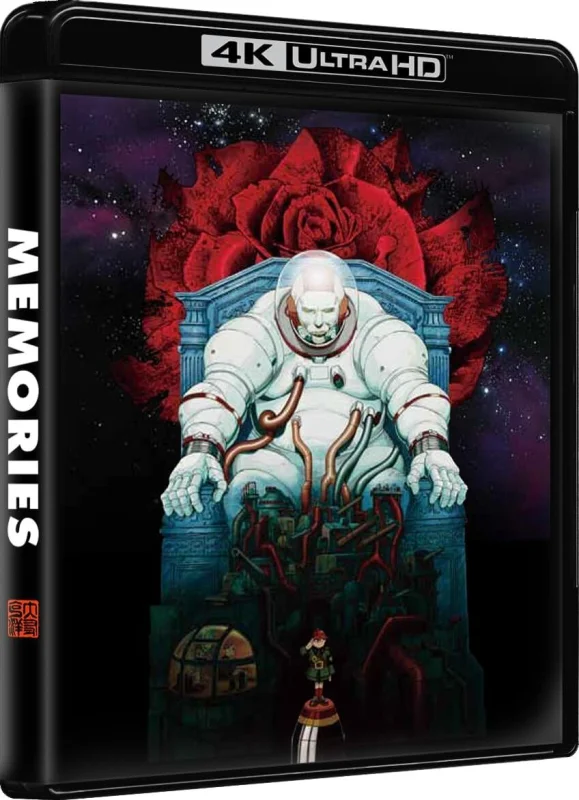
Codec: HEVC / H.265 (88.5 Mb/s)
Resolution: Native 4K (2160p)
HDR: HDR10
Original aspect ratio: 1.85:1
#Japanese: Dolby TrueHD 5.1
#Japanese: Dolby Digital 5.1
#Japanese: FLAC 2.0
#English: DTS-HD Master Audio 5.1
Looking back, looking forward, I see no chance for this planet. Someday, another mad scientist will create a small black hole in the bowels of the Earth with his latest experiment (a new supervirus, a megabomb, a langelier, take your pick). Or a global war will break out between everyone, cities will turn into superweapons, people will be nothing more than cannon fodder, the service personnel of these weapons, and one day the planet will split apart under the weight of endless explosions, like an empty nut shell.
And it will be good if people manage to escape into the sky in star ships, in order to spend eternity flying to distant stars, living only on memories. Because they will have nothing else left.
The three stories in Memories differ in their drawing style, presentation, mood, and plot. They are simply three views of the dystopian future of humanity. A kind of apocalyptic mini-anthology. Ironic, virtuosic, bitter, at times overly exaggerated (the second episode). Like any anthology, it is somewhat uneven. Like any dystopia, it is full of grim warnings to humanity. Starting with Orwell, every generation of science fiction writers has written about essentially the same thing, but humanity is confidently moving along a predetermined vector, fulfilling the worst predictions and treating warnings as instructions to be followed.
Memories is not an oxymoron or a beautiful turn of phrase. It is a necessity to remember that tomorrow is created today, the year 2014 is created in 2013, and the 22nd century is created in the 21st. The future is not somewhere beyond the horizon; it is created here and now. A future of bombs, destroyed ecology, and complete spiritual emptiness, leading to a world like 1984 or Fahrenheit 451. We are our future.
Obviously, when talking about such projects, it is easy to get carried away with excessive pathos, because we live here, and if not us, then our children and our children's children. But if we abstract ourselves from lofty words, we will see in Memories the bitter beauty of Magnetic Rose, the cynical and absurd banter of Stink Bomb, and the steampunk militarism of Cannon Fodder. We will see how good intentions pave the road to you-know-where, how it is possible to achieve immortality by exchanging the real world for endless memories, how chimeras on the roofs of houses turn into cannons, and how children dream of killing the enemy from an early age. Three versions of the future, none of which offer pleasant prospects. Another attempt at a warning. Or a guide to action.
 Telegram and be the first to know about updates!