Login / Register
Guest
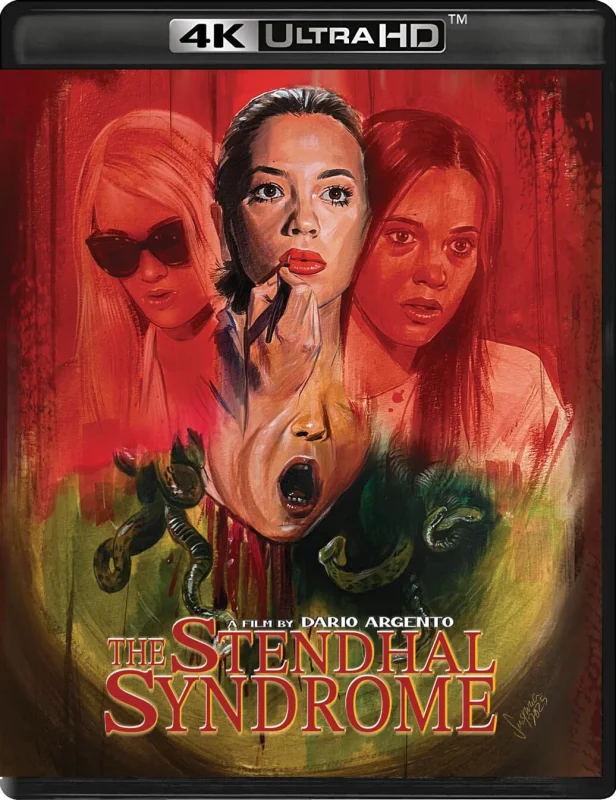
Codec: HEVC / H.265 (91.2 Mb/s)
Resolution: Native 4K (2160p)
HDR: Dolby Vision, HDR10
Aspect ratio: 1.85:1
Original aspect ratio: 1.85:1
#Italian: DTS-HD Master Audio 5.1 (48kHz, 24-bit)
#English: DTS-HD Master Audio 5.1 (48kHz, 24-bit)
Blood flows down the blade, glistening in the darkness, shamelessly scarlet, bright... Hands in leather gloves reach for the white, delicate neck... Black lace, red lipstick...
Jallo died in the late eighties, leaving behind a bloody red memory. And again it rose from the ashes in 1996, blooming like buboes of the plague among the fleur d'orange in “The Stendhal Syndrome.” Glory to Jupiter, who escaped the wandering ‘terminators’ of “The Wax Mask.” But with slight deviations from the “yellow” canons. The killer does not hide or lurk behind the scenes. He appears to the public in all his joyfully perverted nature, raping, revelling in bloody salty kisses, using a gun more gracefully than a knife or a garrote. But all this originality is only at the beginning of the film, then the newly minted Jack the Ripper seems to have become shy and hidden behind the classic killer's-eye view, because not everything is as simple as it seems. And corpses sometimes walk among the living, whispering strange and frightening phrases to them, which take root and bear poisonous fruit. Especially since the soil is very fertile. Stendhal syndrome is a disease as exquisite and beautiful in its own way as Anne of Austria's idiosyncrasy towards roses. And Argenzo shows it with all possible authenticity, which is not surprising, since the director has experienced such an influence of art on himself. And now he has made his daughter relive it on screen. Although Asia initially appears in this film in a sweet image that is unusual for the viewer, she later becomes the familiar bitch, still without tattoos and piercings, but with the familiar hoarseness in her voice and brutal mannerisms that cannot be hidden under a blonde wig.
Compared to Argento's vivid images, the urban surrealism of Nolan's Inception loses all its brilliance and originality. The Stendhal Syndrome is not without its share of pure Italian irony. The “living” graffiti is no less entertaining than the Coca-Cola in Demons.
A touch of paranoia, Stendhal syndrome, a drop of the director's darkness and nightmares transferred to the screen, all for the sake of making the viewer's consciousness shrink like a rose blackening and withering as a vampire approaches, and tremble like the skin on the neck in anticipation of a kiss or a dangerous razor.
 Telegram and be the first to know about updates!