Login / Register
Guest
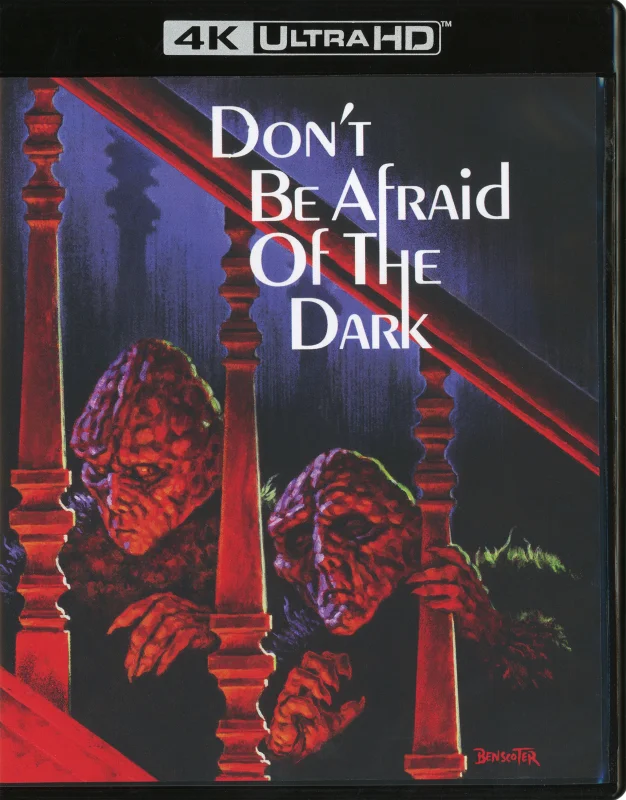
Codec: HEVC / H.265 (93.1 Mb/s)
Resolution: Native 4K (2160p)
HDR: Dolby Vision, HDR10
Aspect ratio: 1.33:1
Original aspect ratio: 1.33:1
#English: FLAC 2.0
#English: FLAC 2.0 (Commentary by author/telefilm historian and Made for TV Mayhem podcaster Amanda Reyes)
#English: Dolby Digital 2.0 (Commentary by Dread Central's Steve 'Uncle Creepy' Barton, "Final Destination" screenwriter Jeff Reddick, and Fangoria magazine writer Sean Abley)
The film “Don't Be Afraid of the Dark” is a classic horror film, whose concept is based on the simplest, but no less frightening theme for horror—the fear of darkness. Of course, in this context, there is no point in talking about anything new for the genre shown in this film. The theme of fear of the dark had been explored in works of this genre long before this film: there was no shortage of “scary” folklore, popular beliefs, and novels by famous horror writers, primarily the novels of Howard Lovecraft. But the film Don't Be Afraid of the Dark is unique, oddly enough, precisely because it is mundane to the core. Right from the start, its creators confront the viewer with the fact that, supposedly, strange creatures dwell in the darkness and, for some reason, are very keen to drag the main character down into the fireplace, where their lair is supposedly located. Did you notice? I wrote the previous sentence uncertainly. This is not surprising, because the entire film is based solely on the fact that the viewer constantly has questions while watching it, to which they do not receive answers (apparently not planned by the screenwriter), and it is not the case where you want to figure it out for yourself.
Look: there is darkness, there are strange evil creatures set free and wanting the death of the main character, but is there anything else in this film that makes it worth watching—is it scary at all? Any of you would ask this logical question, but unfortunately, there is no clear answer. Judge for yourself, as they say. Horror movies vary. For example, Paranormal Activity will definitely scare any viewer, no matter what they say (provided they watch it alone late at night). The horror movie Don't Be Afraid of the Dark is a special case. Here, it all depends on the person watching it. Let's say a viewer suffers from nyctophobia (fear of the dark), then Don't Be Afraid of the Dark (especially the dark scenes) will definitely scare them to death. Children... This film can also have a strong impact on them, but what parent would allow their child to watch Don't Be Afraid of the Dark alone? As far as I know (at least from my own experience), children are already afraid of the dark. Fear of the dark is natural for children, but it goes away with age... for almost everyone.
I can say only one thing with certainty about this film: if Don't Be Afraid of the Dark were based solely on scenes in semi-darkness and pitch darkness, the film would be priceless and would be a very scary classic horror film. Unfortunately, its creators decided otherwise. The main problem with the film is that Nigel McKind, the screenwriter of Don't Be Afraid of the Dark, for some reason tries to reveal the characters of the main characters and their friends to the viewer, telling us the backstory of their lives and their plans for the near future — in short, he supplements the plot of the film with unnecessary details. It would have been better if Nigel had focused on the scary scenes when writing the script, because that's why people watch horror movies.
 Telegram and be the first to know about updates!