Login / Register
Guest
Codec: HEVC / H.265 (95.4 Mb/s)
Resolution: Native 4K (2160p)
Aspect ratio: 2.35:1
Original aspect ratio: 2.35:1
#Japanese: FLAC 1.0
#Japanese: DTS-HD Master Audio 5.1
#English: FLAC 1.0
#English: FLAC 1.0
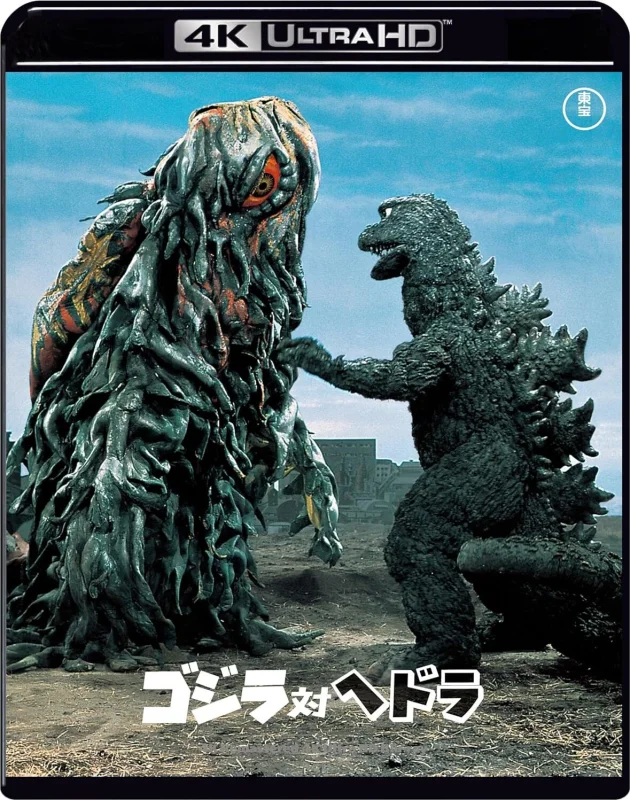
After the tenth anniversary series about the adventures of “Tokyo's number one enemy” – “All Monsters Attack” in 1969, rumors began to circulate that Toho Studios was going to close down. Of course, such a move would have been not only illogical but also extremely absurd, because Godzilla, despite his fierce temper, had been peacefully and obediently laying golden eggs for the studio for decades. The bosses were more interested in whether Godzilla could successfully transition into the new decade.
Let's forget about Honda's original film. It's 1971 — hippies, hard rock, psychedelia, amphetamines! From now on, Godzilla is not a destroyer, he is a defender, a pacifist, he is for world peace! And the only one who can stop him from establishing “universal love” on Earth is a collection of industrial waste, that is, a symbol of technocratic society, a monster named Hedora. Despite his amorphous appearance, Hedora is cool in every way — he swims, crawls, stomps, and flies. He not only throws mud clumps, but also shoots lasers from his eyes. And size doesn't matter to him (no, not in that sense) — today he's a tadpole, and tomorrow he's looking down on Godzilla. But it turns out that Godzilla can fly too, he just was too shy to tell us about it for all these 17 years. So, everything will be fine, and the kids will be able to sleep peacefully.
The film is rightly recognized by many as one of the worst in the franchise. They say that when the film's producer, Tomoyuki Tanaka, saw the film, he felt so ill that he had to be hospitalized. Fortunately, a total disaster was avoided, and the studio's next decision was to save Godzilla at all costs. But it was too late, and the giant lizard slowly and inevitably slid down from the top of Olympus... sorry, Fuji, until it fell into a pit full of foul-smelling and sticky slop, just like Hedorah himself. The subsequent series were no better than the 1971 film. In general, I think the 70s were the most unsuccessful for “Godzilla fans.” Now it's not disaster movies about terrifying monsters terrorizing the Earth's population, but a clown show with colorful costumes and a bad attraction of rubber Teletubbies. Of course, the fairy-tale and comical elements began in the 1960s, but back then the series still had charismatic heroes and interesting plots, as was the case in Godzilla vs. Sea Monster (1966).
The last film of the Showa era, Terror of Mechagodzilla (1975), was a real commercial failure, after which there was a nine-year hiatus.
In 1984, he returned, as dark and evil as he was back in 1954, and the Heisei era began. But that's a whole other story...
 Telegram and be the first to know about updates!
 [/xfnotgiven_poster]