Login / Register
Guest
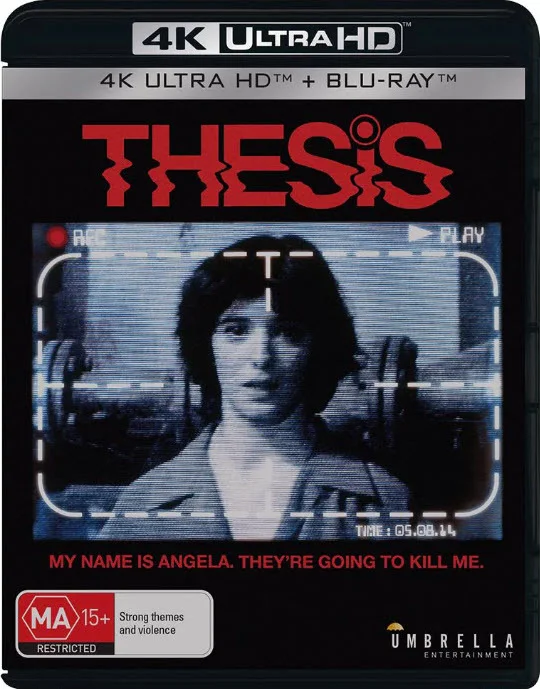
Codec: HEVC / H.265 (62.5 Mb/s)
Resolution: 4K (2160p)
HDR: HDR10
Aspect ratio: 1.85:1
Original aspect ratio: 1.85:1
#Spanish: Dolby Digital 5.1
#Spanish: Dolby Digital 2.0
#German: DTS-HD Master Audio 2.0
#German: DTS-HD Master Audio 2.0
“My name is Angela. They’re going to kill me,” the protagonist of "Thesis" said resignedly into the camera. Before that, Angela had blended into the endless stream of students filling the college hallways every day, and, of course, she had no idea that one of these curious students might turn out to be a psychopathic killer. It all began with a thesis on audiovisual violence; then came a cassette with a snuff movie, a horrifying discovery, and frightening suspicions. Soon, both Angela’s family and friends are drawn into this deadly adventure. The rest of the story resembles a game of ping-pong—there are only two suspects, but over the course of an hour and a half, they manage to swap the title of killer an infinite number of times.
Fans of “slasher” films will find this movie ridiculously naive; despite its bloody and violent subject matter, ‘Thesis’ is clearly not in the “gory” category.
It’s refreshing that in his debut film, Amenábar didn’t follow the path trodden by Hollywood directors—the divergence from American thrillers is enormous. It shines through in the filming style, the actors’ performances, and even the killer’s personality. While in American films the maniac might turn out to be a gardener or a cook, in Amenábar’s film everything is quite obvious, and the main question is: will the obvious turn out to be true?
The torture scenes, kept to a minimum in the film, are compensated for by a twisty and tense screenplay.
In “Thesis,” instead of the cardboard-cutout, dim-witted teenagers—the dominant trope of slasher films—we have characters endowed with psychological depth, intelligence, and motivation. Portrayed by the handsome Noriega and ably supported by Torrent and Martinez, they possess an inexplicable charm.
Instead of the villain’s ridiculous attempts to jump out from around a corner and wave a knife, there’s an emotional whirlwind of the three characters (as well as the currently trendy word “suspense”).
And it’s scary not even because young girls are being sliced up like cabbage—it’s just that, you know, it makes you feel uneasy to think that a sadistic director like that buys a loaf of bread every day at the store near your house.
It’s doubly unpleasant when there’s high demand for his work (a snuff tape costs 10–15 thousand y.e.). It’s disgusting to realize that, as gruesome as it sounds, he’s simply trying to survive in the business world (you know, competition and all that), pandering to the base desires of his finicky and depraved audience. Not everyone is capable of stopping at the line separating the “permissible” from the “unacceptable.” What will happen next?
 Telegram and be the first to know about updates!
 [/xfnotgiven_poster]