Login / Register
Guest
Codec: HEVC / H.265 (63.9 Mb/s)
Resolution: Native 4K (2160p)
Aspect ratio: 1.85:1
Original aspect ratio: 1.85:1
#English: DTS-HD Master Audio 5.1
#French: DTS-HD Master Audio 5.1
#Spanish (Latino): DTS-HD Master Audio 5.1
#Czech: Dolby Digital 5.1
#Hungarian: Dolby Digital 5.1
#Polish: Dolby Digital 5.1
#Russian: Dolby Digital 5.1
#Turkish: Dolby Digital 5.1
#Ukrainian: Dolby Digital 5.1
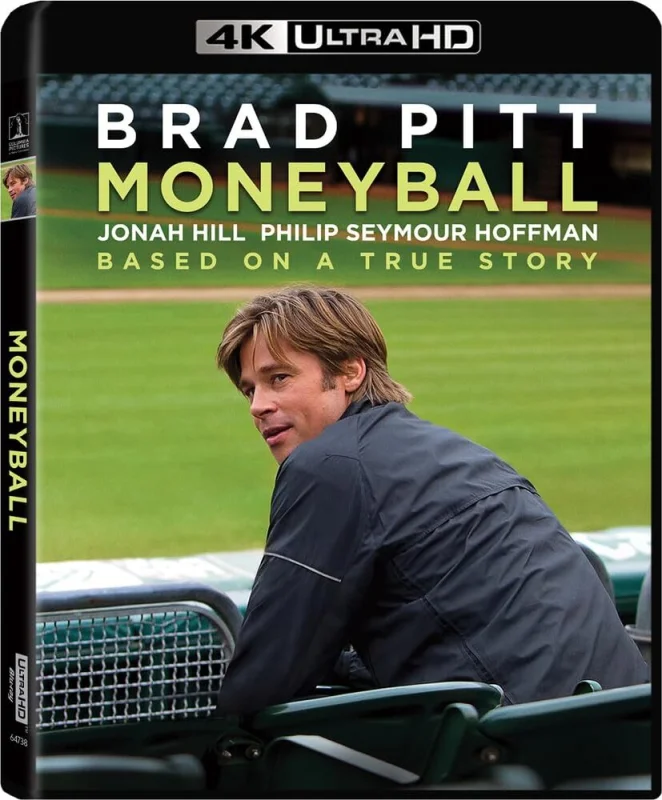
By the time the film hit theaters, it was already clear that in its “story’s” home country, it had garnered the best reviews of the season from both audiences and critics. It’s not at all because the plot centers on a quintessentially American sport, and Americans are ready to go crazy watching a sports drama about baseball starring Brad Pitt. It’s something else. It doesn’t take much to understand what makes this film so appealing to audiences. But aside from the name of the lead actor, there is also the excellent localization of the title itself, despite the fact that it has nothing to do with the original. We live in a time when there is a remarkable category of people for whom changing the order of things around them is by no means an empty phrase. And these people deserve respect.
Many will perceive “Moneyball” as a typical sports drama, where the protagonist, a sports team manager, attempts to rethink the structure of an entire sport and personally influence the course of events, which has long come to resemble a series of unfair decisions. But any sense of “ordinariness” is most often merely a consequence of inattentiveness to the numerous details presented to us. And there are plenty of details here. One of the best screenwriters of our time, Aaron Sorkin, once again demonstrates an incredible approach to character development. Bennett Miller, in the director’s chair, in turn, fully brings these characters to life. There are no oversights here. Miller understands the value of every scene, personally immersing himself in its content and message. Recently, Christopher Nolan’s Oscar-winning regular cinematographer, Wally Pfister, has been imbuing the frame with an ordinary beauty in an unfathomable way, drawing on the very possibilities inherent in the frame itself.
The hardest thing to say is why this film works in our eyes and minds. There is a certain thread that Brad Pitt unravels through his character over the course of the entire two hours. It is that very core that sustains the viewer’s interest. You try to figure out what Billy Bean really wants. This is far from the simple movie it may seem to many. There are no straightforward motives here. And even at the very end, only the most attentive viewers will be able to arrive at the answer if they accurately interpret the lyrics of his daughter’s song—where the meaning lies not in the chorus at all. The chorus is the final point of perception for those who are not ready or willing to delve into this issue to the very end; therefore, the words of a small child describe the situation from different angles, while most will latch onto only the most accessible and straightforward version. This is a film about ideology, if we consider the final stage of our understanding of the entire film. Billy heard “resign yourself.” How many of us hear something like that in life? In reality, very few, simply because most have long since resigned themselves, barely noticing it. People work at jobs they don’t love, build families they don’t understand themselves, succumb to fashion trends, and everything else. And this is not their choice at all. No one chooses to live the life of an unhappy person. And if you have resigned yourself to a state of affairs that doesn’t suit you, then you are unhappy.
 Telegram and be the first to know about updates!