Login / Register
Guest
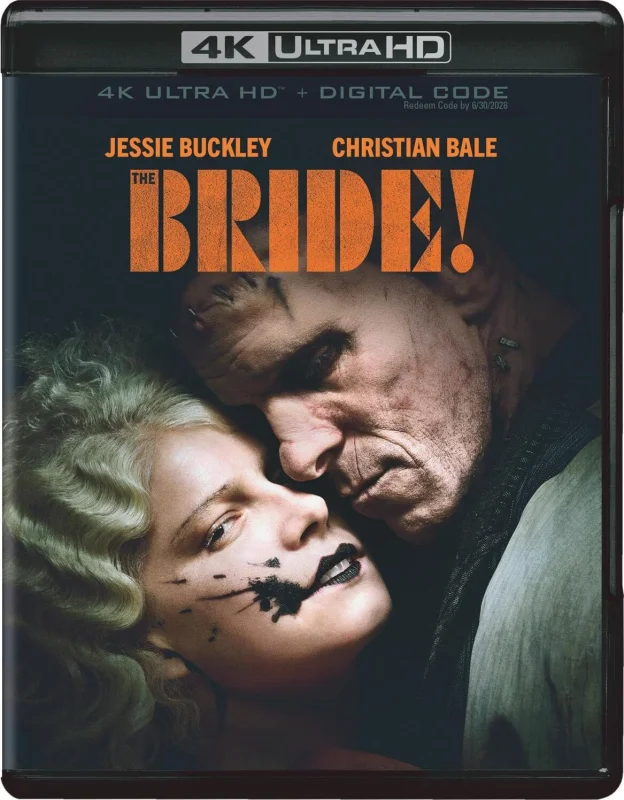
Codec: HEVC / H.265 (69.7 Mb/s)
Resolution: Native 4K (2160p)
HDR: Dolby Vision, HDR10+
Original aspect ratio: 2.39:1
#English: Dolby TrueHD with Dolby Atmos 7.1
#English: Dolby Digital Plus with Dolby Atmos 5.1
#French: Dolby Digital 5.1
#German: Dolby TrueHD with Dolby Atmos 7.1
#German: Dolby Digital 5.1
#Italian: Dolby TrueHD with Dolby Atmos 7.1
#Italian: Dolby Digital 5.1
#Spanish (Latino): Dolby Digital 5.1
Maggie Gyllenhaal, a talented actress and promising director, made a film that was meant to be a manifesto for a woman who has cast off the shackles of all stereotypes, definitions, and destinies. The manifesto is there, but is it really necessary?
Yes, we are once again immersed in the world of Mary Shelley with her modern-day Prometheus. However, the film has only a tenuous connection to the Victorian classic. The hero familiar to us all from childhood—Frankenstein’s monster—is, of course, present. He is still lonely, searching for his other half, and seems to have accepted both his fate and his essence, as well as the entire vile world around him. He safely lived to the 1930s and found Dr. Euphronious (a delightful performance by Annette Bening), who is able to help him. As luck would have it, the body of a deceased young woman has appeared, whose line of work is far from ideal. She is the mistress of a small-time mobster and certainly no role model. Yet it is through her that fate has decided to bring Mary Shelley back to us. Not literally, but rather her spirit, her philosophy, the unspoken grievances toward the world from a weary writer and the widow of a writer. Now the viewer is faced with two women in one body, and it’s unclear who is in charge here. It won’t become clear later either.
Without going into plot details—which would be impossible anyway—I’ll just say that Maggie Gyllenhaal has directed a carnival, a musical, and a clichéd love story. We’ll be shown interpretations of Bonnie and Clyde, Harley Quinn and the Joker, dance numbers set to “Puttin’ on the Ritz.” The characters rewatch Hollywood films and try to find their own place in this fictional world. “Oysters and Illusions”—that’s their motto. Vulgar and innocent, joy and despair, monsters and angels. The bride, having lost her former identity, tries to find a new one among the archetypes and character types imposed by society. There’s a smudge on her face, as if it were a rough draft for her future self. Who is she? Maybe a monster, or maybe a feminist; maybe she’s still a harlot, or maybe she’s become a monster’s bride. She shouts out random phrases and words, rummages through them, searches for meaning, hurls accusations at the crowd. She doesn’t even have a name yet. Does she need a name? Or not. Maybe just “the bride.” No one’s betrothed. No. On her own, belonging to no one, defended by no one, owing nothing to anyone.
This year’s triumphant and already Oscar-winning Jessie Buckley was chosen as the bride. I’ve been following her for a long time. She has earned her fame like no one else. For the past five years, every film, every role has been award-worthy. Probably only she could have taken on—and pulled off—such a multi-layered challenge. The groom is no slouch either—Christian Bale, whose transformations and metamorphoses have long been the stuff of legend. His monster is, as expected, touching, vulnerable, and self-sacrificing.
A gentle accompaniment for the wedding scene.
Nevertheless, despite all this celebration of life and absurdity, the film evokes a dichotomy. Sometimes it feels like we’re watching a masterpiece, and other times a tasteless, clichéd knockoff. So what went wrong? Perhaps the entire feminist message, which at times verges on a scream, no longer resonates with modern realities. We’re tired of it. Perhaps the layering of cultural codes, musical numbers, and genres (romantic drama, horror film, gangster action movie, comedy) creates a cacophony of sounds in which you can’t make out the name of the “star of the show.” Perhaps the influence of Tim Burton’s work and Lady Gaga’s imagery is too evident in the film’s visuals, giving it an air of derivative quality. We could debate this at length, but there’s no point. The illusions are dead, and the oysters have gone bad.
 Telegram and be the first to know about updates!
 [/xfnotgiven_poster]
 [/xfnotgiven_poster]