Login / Register
Guest
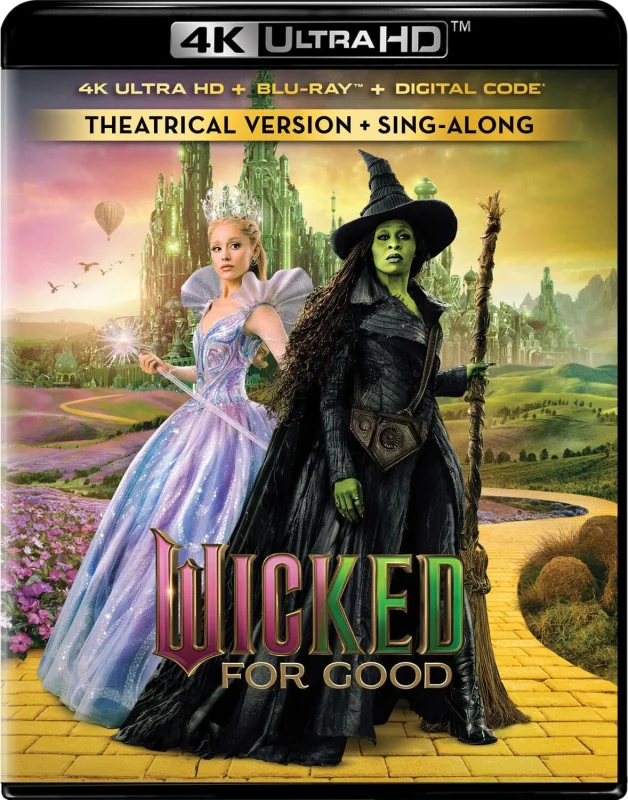
Codec: HEVC / H.265 (68.8 Mb/s)
Resolution: Native 4K (2160p)
HDR: Dolby Vision, HDR10
Original aspect ratio: 2.39:1
#English: Dolby TrueHD with Dolby Atmos 7.1 (48kHz, 24-bit)
#English: Dolby Digital 5.1
#Spanish (Latino): Dolby Digital Plus 7.1
#French: Dolby Digital Plus 7.1
“Wicked” is usually presented as an anthem to feminism, matriarchy, female friendship, democracy, and the fight against the right wing.
There are grounds for this: the original musical is based on Gregory Maguire's book, which touches on almost all of these themes. I give credit to the author—the idea is interesting, but the execution fell short (it's no surprise that in 2014, according to a reputable American website, the book was among the most unread). Therefore, composer Stephen Schwartz wisely decided that the Broadway adaptation needed a woman's touch and invited screenwriter Winnie Holzman. It was she who radically reworked the plot and created the vivid, working images of Elphaba and Glinda.
I dare say that Wicked is primarily about a woman who does not fit into traditional standards of beauty, who is practically alone, slandered, who does good, but, as the saying goes, receives only evil in return. The further the plot moves, the clearer it becomes that Cynthia Erivo's character is not suited to the role of a flat fanatic, but is capable of experiencing and feeling emotions.
Why did the second film fail to live up to high expectations? If we disregard the fact that viewers had forgotten the first part (whose songs contain many hints, especially about the future of the male characters), then I think the green and pink marketing is to blame.
Despite the joint interviews with Cynthia and Ariana, the stylized logo (on the original Broadway poster, the inscription “Evil” is monochrome, I remind you), all the flashbacks and new scenes, the conclusion of the duology turned out to be not about friendship, but rather about rivalry and the further reconciliation of the heroines. It is about how the local “Ugly Duckling” (I think, considering the first film, there is a parallel with the 1999 Colombian series) got tired of fighting the system and decided to choose the first handsome man in the country of Oz, who sacrificed everything for her.
I often see the opinion that Elphaba deserves a different ending and a different kind of happiness. That her suitor is an unnecessary vestige who should be thrown off the ship as soon as possible. And the film adaptation, to please the active fan base, has indeed taken steps in this direction, with virtually no expansion of Jonathan Bailey's character. But still, thanks to the entire creative team for the wonderful musical number “As Long as You're Mine” (even if it stands out in terms of age rating) and for preserving the original ending from the musical.
Returning to my review of the first part, I will answer my own question. Does Maleficent have a social, political, or other agenda? Is there symbolism and room for interpretation? Absolutely. Perhaps years will pass, and all of the above will fade away and no longer be so jarring. But the beautiful fairy tale and songs will remain.
 Telegram and be the first to know about updates!
 [/xfnotgiven_poster]