Login / Register
Guest
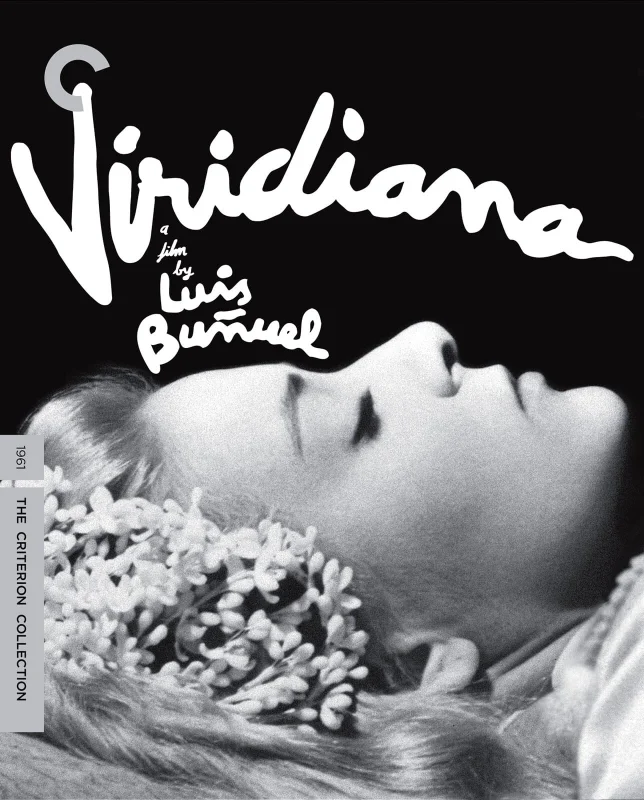
Codec: HEVC / H.265 (83.0 Mb/s)
Resolution: Native 4K (2160p)
Aspect ratio: 1.66:1
Original aspect ratio: 1.66:1
#Spanish: FLAC 1.0
#English: Dolby Digital 2.0 (Commentary by critic Michael Brooke)
Buñuel's first Spanish work after a long hiatus caused a public outcry in Franco's Spain and Catholic Rome, resulting in it being officially banned for a long time.
The original screenplay was written by Buñuel based on an ancient story about a saint who helped the poor and one of his youthful erotic dreams.
Viridiana, a novice nun preparing to enter a convent, visits her elderly uncle, who represents the serpent tempter. Having successfully overcome him, Viridiana becomes neither a bride of God nor a bride of the earth, but, filled with high ideals, decides to help the poor of this world...
In virtually all of his later films, made with the aim of “shaking people up and destroying the conformist laws that forced them to believe that they live in the best of all worlds,” the great Spanish director predicts the collapse of bourgeois society. so “Viridiana” is in many ways an ideological manifesto of his work.
Firstly, the director, a graduate of a Jesuit college, was familiar with the hypocrisy and hidden vices of Catholicism from the inside and lost his faith in God while still a student. In the film, he thoroughly mocks the Catholic Church and its symbols. Buñuel's techniques are harsh and at times even blasphemous: there is a crucifixion in the form of a folding knife and beggars in the role of apostles accompanied by appropriate music.
By casting the sensual and physically beautiful actress Silvia Pinal in the role of Viridiana, whose mere appearance distances one from divine thoughts, Buñuel seems to mock the image of the humble holy nun.
The film demonstrates the death and departure of the old world through the example of Don Jaime, who spent his entire life building castles in the air, but neglected his real estate. And just as in the film Tristana, the hypocritical but generally humane old values are replaced by practical and harsh new orders.
Most importantly, Buñuel's dystopia clearly shows that in a world torn apart by social contradictions, it is impossible to build a society based on universal equality and compassion, which is why the commune experiment fails miserably.
The imperfection of the social system renders Viridiana's naive attempts to save the souls of her charges useless and even dangerous. Ordinary people in this film are antiheroes, and in this respect, the director differs fundamentally from the Italian neorealists.
As in many of his parables, Buñuel brings the events to a relative equilibrium in the finale, without promising a happy future.
The beautifully shot Viridiana raises more questions than it answers, as befits the great works of world cinema.
 Telegram and be the first to know about updates!