Login / Register
Guest
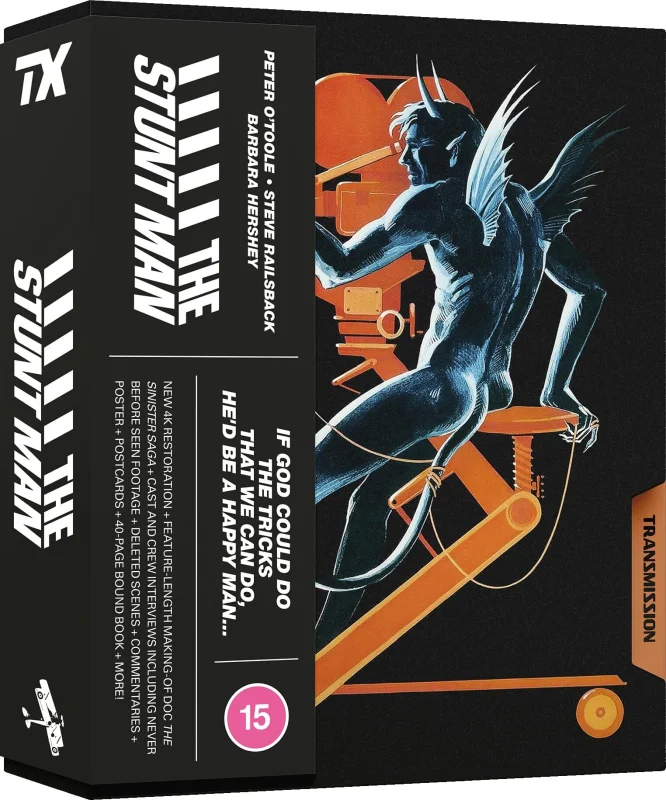
Codec: HEVC / H.265 (93.2 Mb/s)
Resolution: Native 4K (2160p)
HDR: Dolby Vision, HDR10
Aspect ratio: 1.85:1
Original aspect ratio: 1.85:1
#English: Dolby Digital 2.0
#English: DTS-HD Master Audio 5.1 (48kHz, 16-bit)
#English: Dolby Digital 2.0 (Commentary by writer/director Richard Rush and actors Peter O'Toole, Steve Railsback, Barbara Hershey, Alex Rocco, Sharon Farrell, and Chuck Bail)
#English: Dolby Digital 2.0 (Commentary by critics Christina Newland and Monica Castillo)
A certain Cameron, a Vietnam War veteran still full of energy and love for life, escapes from prison and, fleeing from the police, accidentally ends up on the set of a war movie. The uninvited guest's unintentional appearance leads to an accident and the death of the group's best stuntman. The film's director, Eli Cross, continues to be a director in real life: he makes Cameron an offer he can't refuse. In exchange for providing shelter, the fugitive must replace the deceased stuntman.
In his new role, the newly minted stuntman has to perform a series of deadly stunts, each of which could cost him his life. Thus, the safe haven turns into a deadly trap. Cameron has no idea that Cross wants to take advantage of this unique opportunity and, in pursuit of absolute realism, plans to capture the hero's real death right in front of the camera. Especially since he now has the perfect tools for the job...
The reason why this long-suffering film once made it into the sterile Soviet distribution network is easy to discern. As in most American films of that time that were allowed to reach our viewers, here, if one wishes, one can see the notorious criticism of American life – “a society of cleanliness and suppression of personality.” “Human rights violations have become the norm in a decaying imperialism, in which a vain director, in order to satisfy his ambitions, can afford to dispose of other people's lives as if they were his own...” — this is roughly how the synopsis of The Stunt Man might have sounded in our country at the time. But this was only part of the truth; the other half was just the opposite. It was a film about the price of freedom and the right to exercise that freedom.
Such a plot was impossible in Soviet cinema, where for decades people were not left to their own devices: a vigilant society—the state and its agencies—controlled, re-educated, and guided them onto the right path. Therefore, the film, based on Paul Broder's novel The Stuntman, stood out favorably against the general film distribution background and attracted 10 times more viewers to cinemas. But the damned existential question still weighed heavily on the mass audience, which actively flocked to films about movie stuntmen, but under different titles and without any ulterior motives. In 1979, it was Stuntmen, and in 1980, it was The Beast with Belmondo...
In addition, Peter O'Toole “played it up” to such an extent that he demonized Cross, in whose image the features of an infernal demiurge, an all-powerful ruler of souls, gradually began to emerge. Thanks to the actor's efforts, the film gained even more weight, moving into a more prestigious category. O'Toole's role (one of the best in his long list of credits and once again nominated for an Oscar) most likely saved this long-suffering project, which director Richard Rush had already given up on ever completing. But even after filming was completed, the film was not released for another year and a half, and after a month in theaters, it barely recouped its budget.
Today, it is difficult to say for sure what it was: the insight of a mediocre director or the demise of an extraordinary director, finally broken by five years of delays? And if, for example, between 1967 and 1970, Rush shot as many as seven films (Hell's Angels on Wheels, Psycho-Out...), after Stunt Man he was never able to fully recover and made his next film, the erotic thriller The Color of Night, only 14 years later!
 Telegram and be the first to know about updates!