Login / Register
Guest
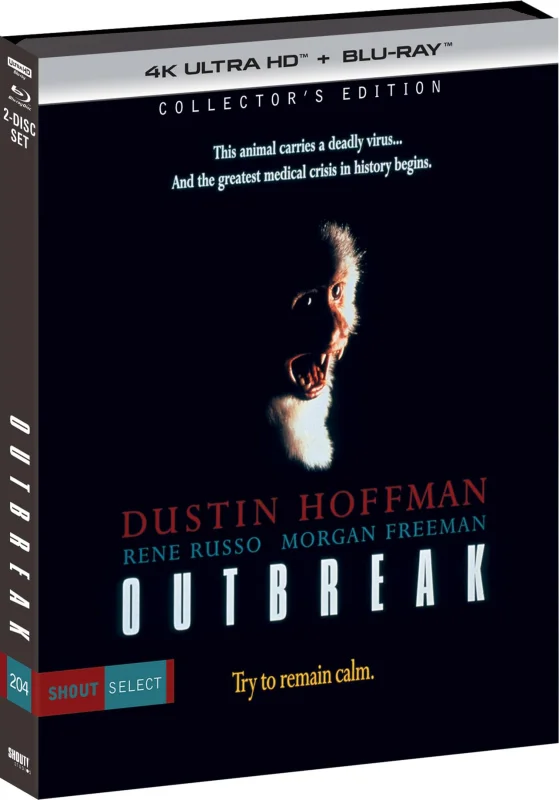
Codec: HEVC / H.265 (86.6 Mb/s)
Resolution: 4K (2160p)
HDR: Dolby Vision, HDR10
Original aspect ratio: 1.85:1
#English: DTS-HD Master Audio 5.1
#English: FLAC 2.0
A decade later, the film "Epidemic" has piqued my interest once again for a number of reasons. First, the sheer number of big names in the creative team—a diverse list that inspires indescribable delight while simultaneously causing a bit of bewilderment. To use soccer terminology, one could say that the film features nothing short of a world all-star team. Of course, at the time the film was released, Wolfgang Petersen was still on his way to becoming a world-renowned purveyor of spectacular blockbusters. Kevin Spacey and Cuba Gooding Jr. were also carving out their paths to universal audience acclaim and recognition of their merits by the American film academy. However, James Newton Howard was already a legend among film composers at that time, and Dustin Hoffman’s participation in such a project was, in my view, an unsolvable mystery, given that the very idea of this actor testing his skills in such a niche genre seems paradoxical in itself.
Of course, I won’t forget that the film "Outbreak" was probably a pioneer in the specific viral-killer subgenre of disaster movies, which was made with a very impressive budget, making active use of modern makeup and expensive visual effects. Secondly, I took notice of the film because of a sudden sense of total injustice, given that "Outbreak" has been undeservedly forgotten by our television executives. The film had a relatively quiet theatrical run and wasn’t shown very often on TV, even though to this day it remains one of the highest-quality examples of spectacular and dynamic “disaster” cinema. The film’s plot unfolds according to the genre’s conventions and formulas. In this regard, the plot development of "Outbreak" is extremely formulaic and, unfortunately, predictable from start to finish. But this is the only drawback of Wolfgang Petersen’s work—and a rather relative one at that, which does not detract from its overall merits.
The plot is conceived by the screenwriters in an extremely traditional manner, without any semantic flourishes. The cause of the deadly and incurable virus’s invasion of American soil will be a small monkey, illegally imported into the States from Africa by a figure of limited intellect. The virus, of course, will begin to spread and is bound to mutate, causing even more problems for the virologists, who are already freaking out from terror and their own helplessness. The film will feature many people in airtight rubber suits and equally airtight helmets. The plot also includes a storyline about the treacherous and truth-concealing U.S. military, who, thanks to their stupidity and indifference, will do everything in their power to ensure that as many upstanding American citizens as possible die from the virus. And the main villain will be played, of course, by Donald Sutherland, for whom the role of a heartless killer has already become a trademark.
Naturally, at the center of the film is the extremely positive and exceptionally gifted main character — a military virologist played by Dustin Hoffman, who not only tries to save humanity from certain doom but also manages to successfully stand up to the serious resistance of his foolish superiors, who are trying to hide their shady dealings in the development of secret biological weapons. The hero is joined by his ex-wife, Rene Russo, also a virologist, with whom he maintains a complicated but generally amicable relationship following their divorce, aside from the sweet and unassuming arguments over which of them will get to keep their two shared dogs. Otherwise, the wife does everything in her power to help her husband in the fight against the African scourge and continues to support his methods and tactics for waging this very battle, which are unpopular among the leadership of the U.S. Department of Defense.
"Outbreak" is saturated with clichéd plot devices, from which it is assembled like individual bricks into a single whole, but, to be honest,
such predictability does not in the least prevent the film from being perceived as a highly effective and gripping spectacle; on the contrary, it makes the entire story extremely cohesive and well-structured. First and foremost, this is facilitated by the absence of unnecessary grandstanding and pseudo-patriotic sentiment—typically American cinematic traits—the “pleasure” of witnessing the development of which the director, to our great delight, has spared us. Wolfgang Petersen’s very solid direction forces us not to pay much attention to all the clichés in the plotlines and character portrayals. On screen, we see a story that unfolds predictably but is skillfully crafted—a desperate struggle of people for their own lives and the lives of their loved ones, without silly slogans or intrusive moralizing (though the film certainly has its own anti-militarist moral).
With every passing minute, the director skillfully builds the tension of the narrative. The state of universal panic gripping humanity in the face of a deadly global-scale threat is very clearly conveyed by Wolfgang Petersen on screen, and the impeccably performing ensemble of talented actors leaves no room to doubt the authenticity of the characters they portray. The film is skillfully directed and visually stunning, especially when one takes into account the year it was made, and it undoubtedly stands out against a backdrop of a whole host of other mindless films in the genre.
 Telegram and be the first to know about updates!
 [/xfnotgiven_poster]