Login / Register
Guest
Codec: HEVC / H.265 (79.8 Mb/s)
Resolution: Native 4K (2160p)
HDR: Dolby Vision, HDR10
Aspect ratio: 1.85:1
Original aspect ratio: 1.85:1
#English: FLAC 2.0
#English: Dolby Digital 2.0 (Commentary by Film Critic Adrian Martin)
A true male-centric director, Scorsese has always made films centered on men, and the women in his movies rarely escape the label of ‘object of desire’. Sometimes, of course, they managed to do so, and a good example of this is the film Alice Doesn’t Live Here Anymore. But despite the film’s obvious artistic merits, I simply cannot bring myself to call it a typical Martin Scorsese film.
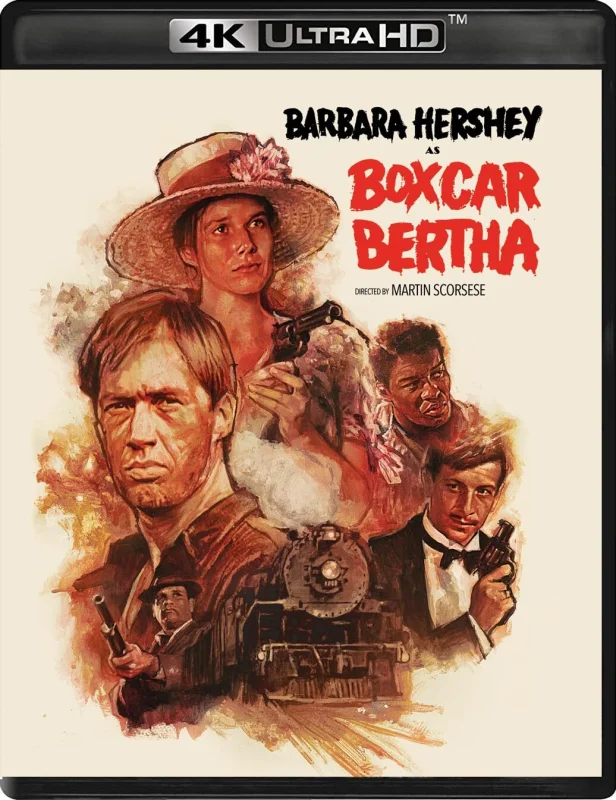
The film that managed to break through Scorsese’s chauvinism while somehow still remaining a Martin Scorsese film was *Boxcar Bertha*, the second feature film by the then-young up-and-coming director.
“B Bertha…B ,” unlike “B Alice…B ,” is unambiguously a Scorsese film—even if he hadn’t yet fully found his own style and manner—but definitely the same Scorsese who directed “B GoodfellasB ,” “B Taxi DriverB ,” “B CasinoB ,” and so on.
I’ll note right away that the plot is definitely not the film’s strongest point. The whole story resembles a brief retelling of the most interesting moments from “Bonnie and Clyde.” The story takes place in 1930s America, during the Great Depression, and people in search of work take to the open road. The focus is on Bertha (Barbara Hershey) and Bill (David Carradine); they rob, kill, give their loot to the poor, and live it up as much as they can.
But as is usually the case in this kind of film—the period of carefree success is followed by capture, arrest, and ultimately the death of several main characters.
I’m telling you, the plot isn’t the film’s strongest point. With the exception of the ending, which deserves special attention, because it is there that the future director’s vision is most clearly evident. It’s unclear how, but in this naive and uncomplicated story about adventures on the open road, the ending suddenly features a crucifixion, a mass murder, and a single dramatic moment of astonishing power, after which the credits unexpectedly roll. Since this film is practically a directorial debut, I can state with full confidence that Martin Scorsese’s entire career began with the ending of “Boxcar Bertha”
As for the acting, I personally consider this film to be a rehearsal for another Scorsese film—“The Last Temptation of Christ.”
Auditions that, in my opinion, were passed by both Barbara Hershey and David Carradine. But in the end, while Barbara got her role, unfortunately, Carradine’s spot was taken by William Defoe.
Apparently because, by that point, Carradine had already seriously tarnished his reputation with the abundance of B-movies in which he constantly appeared.
In the end, the mediocre plot is compensated by decent acting, and in my case, all of this is further bolstered by my interest in the director.
 Telegram and be the first to know about updates!