Login / Register
Guest
Codec: HEVC / H.265 (63.9 Mb/s)
Resolution: Native 4K (2160p)
HDR: Dolby Vision, HDR10
Aspect ratio: 1.85:1
Original aspect ratio: 1.85:1
#English: DTS-HD Master Audio 5.1
#German: DTS-HD Master Audio 5.1
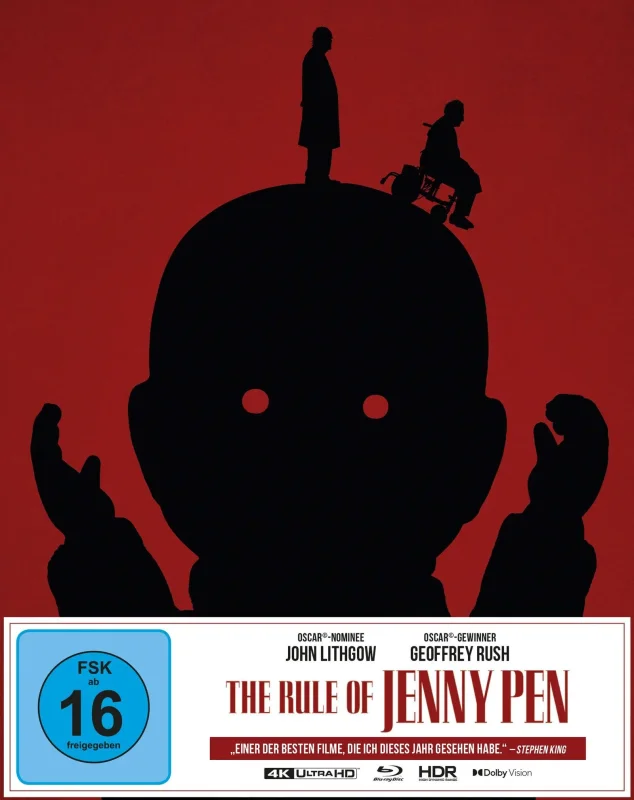
Life in a nursing home—even with the most caring staff—is difficult. An elderly judge recently suffered a stroke and cannot come to terms with his helplessness. His neighbor—a former athlete—finds solace in chatting with his grandchildren online. And Dave Creely carries an ugly doll in his hand and finds solace in humiliating and tormenting the other patients...
‘Old age is no joy,’ as the saying goes. Not even in the most beautiful nursing home. Everyone ends up here through their own winding, personal path. And there is only one way out. The same for everyone.
It’s a slow fading away. Yesterday you were a full-fledged member of society. You had plans. A future. And then—boom. A stroke. Alzheimer’s. Parkinson’s. Dementia. What needs to be underlined can no longer be crossed out. You walk into a room and don’t remember why you came in. Or where this room is. Or what your name is.
So a movie about old people is always a bit of a horror story—whether it’s a drama (*Life*, *The Whirlwind*, *The Father*), sci-fi (*Cocoon*), an animated film (*Up*), or a fable (*A Simple Story*). ‘The House of Death’ (originally titled ‘Jenny Penn's Rule’) doubles the horror—it’s not just a story about old age, but also a thriller about a psychopath. Geoffrey Rush and John Lithgow are utterly fearless. Because they aren’t afraid to show themselves to the audience exactly as they are. Exposed—in a metaphorical, and sometimes literal, sense.
John Lithgow also adds to his collection of memorable psychopaths (his Trinity from ‘Dexter’ is unforgettable). His character, Dave Creely, is a rather unusual maniac. His victims are his neighbors in the nursing home. His weapon is an ugly doll named Jenny Pen, strapped to his arm. His motivation is power—even if it’s over a bunch of old folks. He simply takes the saying “We stop playing not because we grow old. We grow old because we stop playing” to heart. And Creely plays.
Jeffrey Rush’s character, on the one hand, is his complete opposite: he doesn’t want to harm anyone. He doesn’t want to interact with anyone at all. But, on the other hand, the motivation of his character, Judge Mortensen, is practically the same as Crilly’s. To retain what little control he has left over his life. And if he can’t return to the courtroom and put on his robe, then at least pick up that damn glass. The bathroom scene with his character is one of the most chilling in the film: and yet there isn’t even a maniac there. Old age—that is the main maniac in this abode.
While watching, my anger and emotions were directed not even at the man with the doll in his arms, but at the staff of this, generally speaking, not exactly run-down facility—you could say everything there is top-notch. But they deny the patients the most important thing—the right to a voice, the right to make decisions. After all, they aren’t prisoners, but patients. And that means they no longer have the right to their own lives. And their complaints and fears are just fantasies.
You might say: that doesn’t happen. Surely someone must see what Krilly is doing. Just turn on your surveillance camera and check. It’s that simple. But the horror of this story lies precisely in the fact that this is exactly what happens. Sick elderly people no longer have a voice or the right to make decisions. Simply because they are old. Perhaps this is what is known as “Jenny Pen’s rule.”
 Telegram and be the first to know about updates!
 [/xfnotgiven_poster]