Login / Register
Guest
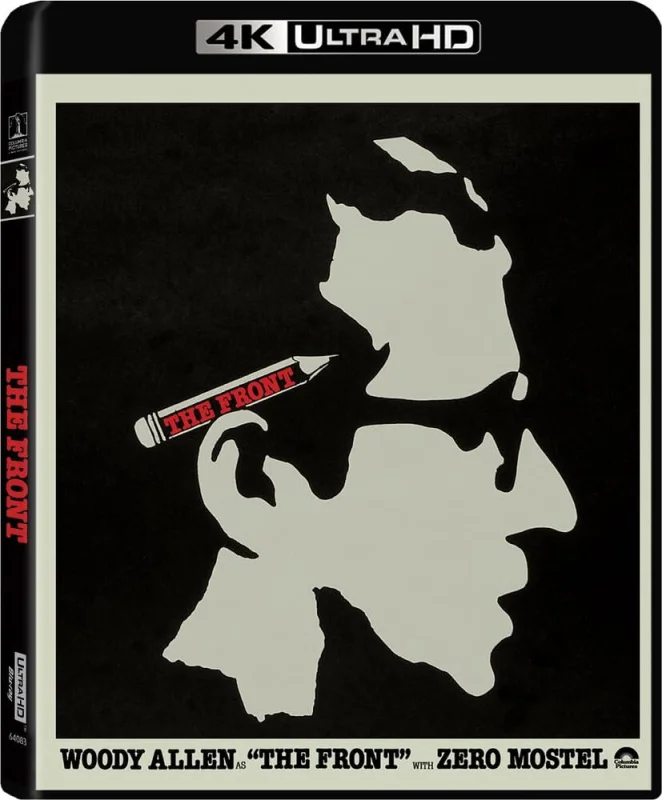
Codec: HEVC / H.265 (75.1 Mb/s)
Resolution: Native 4K (2160p)
HDR: Dolby Vision, HDR10
Original aspect ratio: 1.85:1
#English: FLAC 2.0
#English: Dolby Digital 2.0 (Commentary with film historians Julie Kirgo and Nick Redman and actress Andrea Marcovicci)
Another fine performance by Woody Allen—on par with *Play It Again, Sam*—in a film directed by someone else, though this time he didn’t even write the screenplay. The film turned out to be a scathing critique: no wonder, since it was created by a host of filmmakers who had once been blacklisted for sympathizing with the “left,” meaning they knew exactly what their film was about. Mirtin Ritt’s *The Front Man* is a drama with elements of comedy, whose main goal was to showcase the courage of the “little man” who defied a system of suppression and dissent, making it highly relevant wherever freedom of speech is under attack. Although Woody Allen does not play an intellectual here, he is extremely convincing in the role of a man modest about his talents, unafraid to maintain his dignity in an atmosphere of universal fear.
For this reason, casting him in the lead role was a very successful choice. However, the storylines of the other characters, including the tragic arc of Haggy in Zero Mostel’s brilliant, ironically burlesque performance, also add to the film’s appeal, transforming Ritt’s film into a cinematic novel where all the characters are equally important. “The Front Man” tells the story of the gradual awakening of conscience in a man who is far removed from politics but constantly confronted with injustice; thus, his final gesture—though meaningless and fruitless—becomes a metaphor for defending one’s own dignity and that of others. Thus, the fact that Howard Prince represents disgraced TV writers becomes an allegory of political and ideological representation—he commits an act of defiance against unjust authority both on their behalf and in his own name.
In this film, Woody Allen once again demonstrated his ability to play serious dramatic roles, though not without a touch of comedy (his character is so amusing in and of himself, so endearing and touching); perhaps it was precisely the role in *The Stand-In* that finally convinced Allen of the need to move in his own films from burlesque and harmless tomfoolery to something more serious. Ritt’s film also features a rather charming romantic subplot, presented with the conviction that ideological compatibility is necessary for lovers to achieve complete happiness. In his directorial works, starting with *Annie Hall*, Woody Allen has always depicted the daily lives, routines, dramas, and concerns of American intellectuals known for their “left-wing” sympathies.
He always poked fun at his characters’ views, but for him it was important above all to show their inability to adapt to everyday life; however, in Ritt’s film, he allows himself, through his role, his very manner of performance, his physicality, facial expressions, and intonation, to unequivocally speak out against any persecution of dissent, the stifling of free speech, and totalitarian political tendencies. Made by “leftists” and for “leftists,” Ritt’s film can also be seen as a movie about the USSR, where “ordinary” people, intellectuals, and thinkers also live—people far removed from cynicism and immorality, who cherish the value of friendship and love, and most importantly—capable, when the occasion demands it, of standing up against injustice, defending their own and others’ dignity. Watch Martin Ritt’s *The Front* and learn from Woody Allen’s character the courage of spirit, even if it is hidden behind an unpresentable exterior.
 Telegram and be the first to know about updates!