Login / Register
Guest
Codec: HEVC / H.265 (75.1 Mb/s)
Resolution: Upscaled 4K (2160p)
HDR: Dolby Vision, HDR10+
Aspect ratio: 1.85:1
Original aspect ratio: 1.85:1
#English: DTS-HD Master Audio 5.1 (48kHz, 24-bit)
#English: Dolby Digital 2.0 (Commentary with director and writer Charlotte Wells)
And there’s this feeling—once you leave the place where you’re from, where you grew up—that, um, you don’t quite belong there anymore.
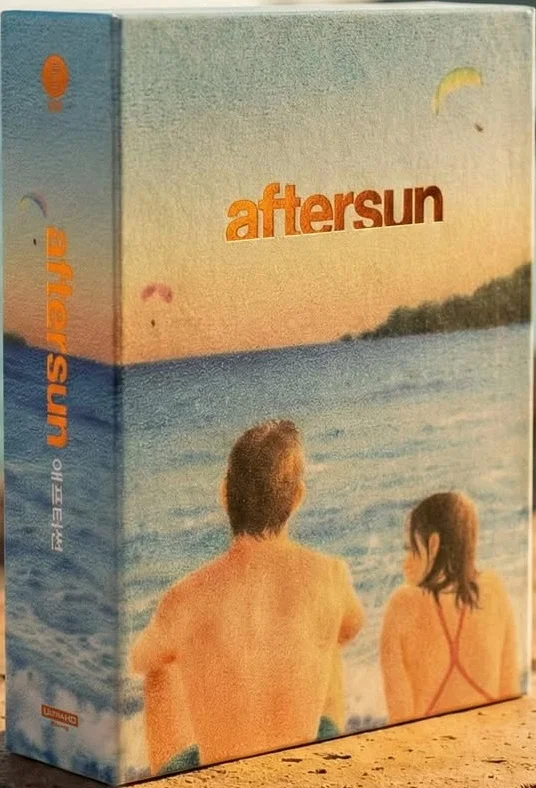
“Aftersun", as the film’s title sounds without localization, is, above all, a coming-of-age story. A young—yet no longer young—father spends a week on vacation with his 11-year-old daughter. He hasn’t lived with his ex-wife for a long time; he left his native Scotland and drifts from hotel to hotel. The man is clearly lost in life’s labyrinths, unable to get his personal life in order, yet he loves his daughter dearly.
The girl, precocious for her age, is just beginning to discover the world. And along the way, she constantly turns to her wise (as is typical with adults) dad for guidance. She teases him in a childish way and wishes him a happy 131st birthday. Dad tries to be wise, too. He protects her and, through clumsy but sincere advice, tries to pass on to his daughter everything he knows.
Here’s how to properly draw a knife in a scuffle, and here’s how to choose rugs. Passing on these “useful” skills is both a deep trauma of miscommunication with his daughter and, at the same time, a zealous attempt to share his experience. He communicates as best he can
“Aftersun” is a film about just two people.
Their summer, their world, their universe. Only the two of them exist. It will last just a week. She’ll return to her mother in Edinburgh; he’ll continue wandering through hotel lobbies in search of a home. But no one will ever be able to take this time away from them.
Father and daughter—a far less hackneyed plot than the relationship between a mother and son. Sophie and Callum’s paths diverged very early on, and after this “After Sun,” they will drift even further apart. Her life is in her own hands—that’s what her dad tells her directly—“Be whoever you want to be, live wherever you want to live; you still have time.” His life, on the other hand, is sporadic and broken. Although to his daughter, he remains a 131-year-old alligator who knows the answers to all questions.
Scenes of a resort idyll rapidly give way to glimpses of Sophie’s adult life. She’s 31 now, and she doesn’t know where her father is. But every man dancing in the club reminds her of him. She recalls how her dad taught her to dance to a cheesy Turkish pop song by the pool, reminding her once again that in this world, it was just the two of them. The young woman watches the tapes from the hotel on an old VCR—tapes she apparently keeps carefully stored in the most private corner of her home.
Sophie’s life didn’t get any easier; other people and problems entered her life, and her dad was gone. After a parent’s passing, a person loses their anchor, their faith in magic and electricity. I still don’t understand how girls who were deprived of fathers from childhood watched this movie.
Beyond being a good drama and a reconstruction of a lost paradise, *Aftersun* seriously aspires to be a well-made auteur film. Debut director Charlotte Wells plays with reflections on par with Antonioni, conveying meaning through double mirrors and cathode-ray tube television screens. This film, which will unfairly be remembered solely for Paul Mescal’s performance, is very conceptually crafted. Very. It’s the kind of film you can watch over and over again, discovering new layers of meaning in every frame.
Ultimately, “Aftersun” is a film about those we often forget—those who, often unseen, built our lost paradise. Love your dads, hug them, and don’t forget them. They deserve it just as much as moms do, but they’re far more often overlooked.
 Telegram and be the first to know about updates!