Login / Register
Guest
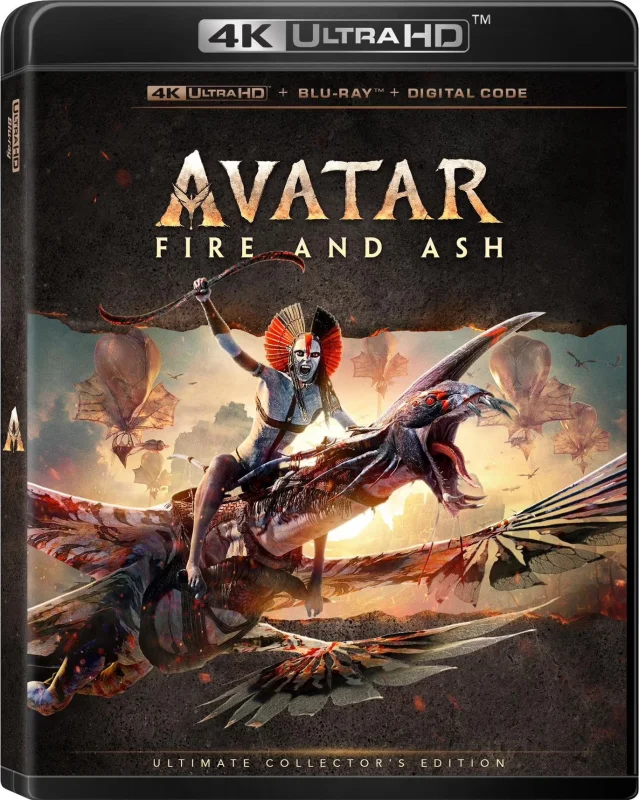
Codec: HEVC / H.265 (47.8 Mb/s)
Resolution: Native 4K (2160p)
HDR: Dolby Vision, HDR10+
Aspect ratio: 1.85:1
Original aspect ratio: 2.39:1
#English: Dolby TrueHD with Dolby Atmos 7.1 (48kHz, 24-bit)
#English: Dolby Digital Plus with Dolby Atmos 5.1
#Spanish (Latino): Dolby Digital Plus 7.1
#French (Canada): Dolby Digital 5.1
There were certain expectations for the nominal antagonist of the third installment of the saga about the inhabitants of Pandora—and beyond. There was a glimmer of hope that Varang would become that embodiment of absolute evil that you watch, if not with your jaw hanging open, then at least with a barely perceptible inner shudder. That didn’t happen. Visually, however, the Tsahik of the Ash Clan definitely outshines everyone else. And it’s not just about Varang’s design—which is truly impressive—but also about Una Chaplin’s performance, as she conveyed hints of madness and obsession with genuine ease. But Una isn’t the only thing that makes the film stand out: there are definitely moments in it that are also worth paying attention to.
The first is an unshakable sense of being secondary to the first two ‘Avatars’. This feeling can be annoying, but for me, oddly enough, it evoked a barely noticeable nostalgia for the days when Stephen Lang portrayed the colonel without motion capture. To be fair, it’s worth noting that the painfully familiar plot devices and twists are woven quite organically into the overall story. Personally, the narrative didn’t feel disjointed to me, so while I wouldn’t say the nearly 3.5 hours in the theater flew by unnoticed, they did pass without me constantly glancing at my watch or wondering, “When is this going to end?” After all, Cameron did his best to combine the best of the two previous films while also bringing something new to the table.
And here we come to the second point. This may seem too subjective and far-fetched, but I believe that in *Avatar: The Way of Fire*, there was a significant shift in the depth of the characters’ emotional experiences. The film literally begins by showing us the different ways grief can be experienced. As the story unfolds, the emphasis on the moral ambiguity of individual characters’ actions intensifies. Complex emotions take center stage, in some cases capable of bringing a tear to the eye.
In summary, I’d like to say that this film is, first and foremost, one big piece of entertainment. Entertainment that may seem bigger than it actually is, but doesn’t lose its appeal because of it.
 Telegram and be the first to know about updates!
 [/xfnotgiven_poster]