Login / Register
Guest
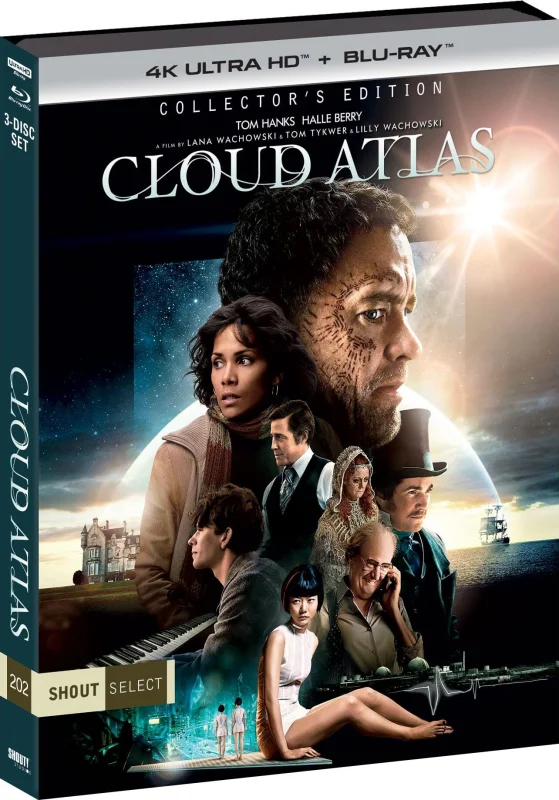
Codec: HEVC / H.265 (61.2 Mb/s)
Resolution: 4K (2160p)
HDR: Dolby Vision, HDR10
Original aspect ratio: 2.39:1
#English: DTS-HD Master Audio 5.1
#French: Dolby Digital 5.1
#Spanish (Latino): Dolby Digital 5.1
David Mitchell, in his novel, followed by Tom Tykwer and the Wachowski sisters in this film, brilliantly illustrated the philosophy of reincarnation, according to which a living being (soul), being born, dying, and being reborn in the material world, changes its bodies like clothes. Each new body (and the initial circumstances of life in that body) is given to the soul according to its qualities, inclinations, and desires, developed over a long series of previous incarnations. The film traces a small part of them: from three to six incarnations of the key characters shown to us. According to this philosophy, the individual chooses for themselves in which direction to develop and how to act in given circumstances. That is why the actors play several characters in the film, showing the development of one soul from life to life in different bodies (incarnations), circumstances, and eras.
The most consistent positive development can be seen in the character of Jim Sturgess: from life to life, he is kind and noble and helps those who are changing the world for many. The most negative path is taken by the character of Hugo Weaving, whose increasing villainy reaches its peak in the last incarnation shown. The most zigzagging line of development (I deliberately do not write ‘line of fate’, as fate is associated with predetermination, even doom, for European viewers) is that of Tom Hanks' character, who swings from selflessness to greed and back again, from vanity to detachment, He is full of doubts, a desire to live brightly and at the same time safely, he fights his inner demons more desperately than anyone else, changes from life to life noticeably more than the other characters, and in the end gets a chance to positively influence the fate of humanity. In the film, those who have the strongest influence on humanity in this incarnation are marked with a birthmark in the shape of a comet.
In my opinion, everything in the film is wonderful: from the stories of individual characters to the history of the development of society (which is quite plausible, judging by the observed trends), from the acting to the cinematography... What pleases me most is the composition—comprehensive, polyphonic, but harmonious, like the symphony “Cloud Atlas” written by Robert Frobisher, one of the key characters and the most ambiguous, as is often the case with geniuses.
In making this film, the directors probably wanted to introduce the Western world to the concept of reincarnation, which teaches us to look deeper and further, to see the world in its entirety and the intertwining of lives, and explains everything that happens in a comprehensive way through cause and effect, rather than blind chance. It is difficult to say how successful this attempt was. Judging by the comments, for those who are unfamiliar with the concepts of reincarnation, karma, vicarma, and akarma, this film seems more like a cacophony than a coherent story. But perhaps it will touch someone, prompting them to take a closer look at those around them and themselves, and to view the flow of life with a slightly broader and more thoughtful gaze.
 Telegram and be the first to know about updates!