Login / Register
Guest
Codec: HEVC / H.265 (74.9 Mb/s)
Resolution: Native 4K (2160p)
Aspect ratio: 2.35:1
Original aspect ratio: 2.39:1
#Korean: Dolby TrueHD with Dolby Atmos 7.1 (48kHz, 24-bit)
#Korean: Dolby Digital Plus with Dolby Atmos 5.1
#Korean: DTS-HD Master Audio 5.1 (48kHz, 24-bit)
Park Chan-wook directed a tribute to Costa-Gavras’s film *The Guillotine*. It turned out to be very dark, at times scary, at times funny, and sometimes hilariously scary.
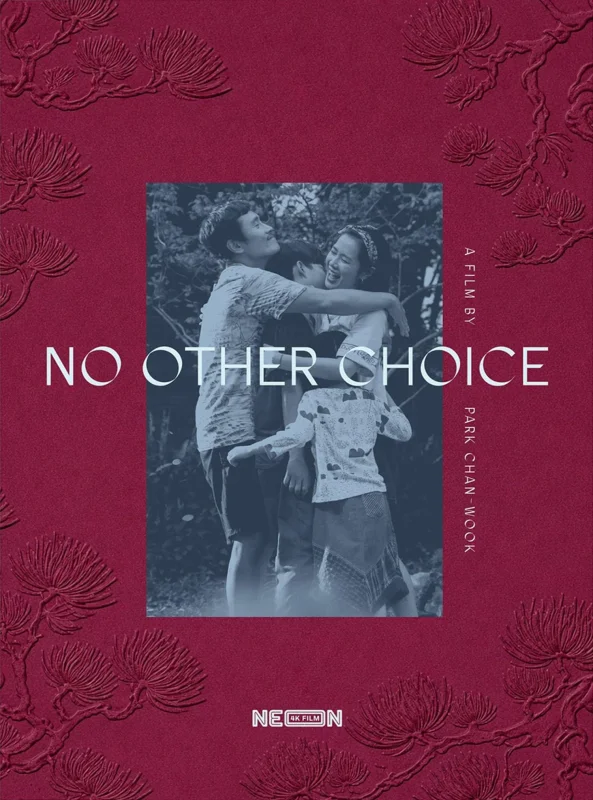
The promotional poster features a tree. Why a tree? What kind of symbol is that? Buffalo Bill from *The Silence of the Lambs* associated himself with a caterpillar, waiting to transform into a beautiful butterfly. Yoo Myung-soo, an unemployed manager in the printing industry, is constantly fiddling with trees. This doesn’t mean he’s a blockhead. A tree is a symbol of growth and rebirth; clearly, this is a hint at the hero’s return to work. Just as the aching tooth causing Yoo Myung-soo so many problems symbolizes the need for a radical, surgical solution.
How will Yu Men-Su get his job back? For those who have read Westlake’s novel, on which Gavras’s film is based, or have seen the film itself, the answer is clear. Yes, it’s a bit illegal. But what is the law? It expresses the will of the economically dominant class. Yu Men-su is not a revolutionary; he is a conformist operating within the framework of the existing economic model. Consider his actions competition—unfair, perhaps, but competition nonetheless. The market has decided.
The film is shot with great elegance. The magnificent Korean autumn showcases the various stages of nature’s withering. The rich color palette ranges from deep, vibrant green to lush crimson (the trees were planted so that they would change color in succession). The director uses unusual camera angles—inside the protagonist’s mouth (Hello, Oldboy!), at the bottom of a whiskey glass, and other cinematic delights.
Park Chan-wook has a talent for combining the tragic and the comic. From the absurd, Homeric-style comedy of the first murder scene to the transformation of crime into a fine art, it’s a two-hour journey. This is a genuine, masterfully shot film.
The form is beautiful. But what about the content? “A film about the horrors of capitalism”? We see the story of a middle-class man accustomed to everything sweet, tasty, soft, and cozy. Getting fired doesn’t mean he’ll starve to death. But he’ll have to move from his own house to an apartment; his wife will have to give up tennis, his daughter her cello lessons, and his little son (oh, the horror!) will be left without Netflix! White-collar workers aren’t ready to make such sacrifices. The protagonist will fight! But not against the system, and not against those who left him unemployed. But against fellow misfortunates, his colleagues in misfortune. Thus, we see a story of intra-species struggle. No revolutions, no class struggle. Such things don’t even cross his mind. The English title of the film is ‘No Other Choice.’ You die today, and I'll die tomorrow! The main character remains within the confines of this rat-like morality. In the finale, there is a scene that clearly demonstrates that Yoo Myung-soo couldn't care less about the interests of the working class. Solidarity? No, a warm diaper is closer to the body.
The sweet, handsome Lee Byung-hun has aged; his face has broadened, wrinkles have appeared, and there’s weariness in his gaze. Throughout the film, people compliment him—‘You’re just like a fashion model!’—but the treacherous close-ups shatter this illusion. The worst that threatens him now is this photo finish.
I saw yet another attempt to gnaw at capitalism with toothless gums. Harmless criticism of the market is trending right now. Bong Joon-ho with his *Parasite*, now Park Chan-wook with "No Other Choice". It’s all very sterile and harmless. “No other choice”? October 17th suggests otherwise. The art of bonsai involves twisting the trunk with wire. The result is a beautiful, lush, sprawling... dwarf.
 Telegram and be the first to know about updates!
 [/xfnotgiven_poster]