Login / Register
Guest
Codec: HEVC / H.265 (94.1 Mb/s)
Resolution: Native 4K (2160p)
HDR: Dolby Vision, HDR10
Aspect ratio: 1.85:1
Original aspect ratio: 1.85:1
#English: FLAC 1.0
#English: Dolby Digital 1.0 (Commentary by film historians Nick Redman and Julie Kirgo)
#English: Dolby Digital 2.0 (Commentary by film historian/filmmaker Daniel Kremer and filmmaker Henry Jaglom)
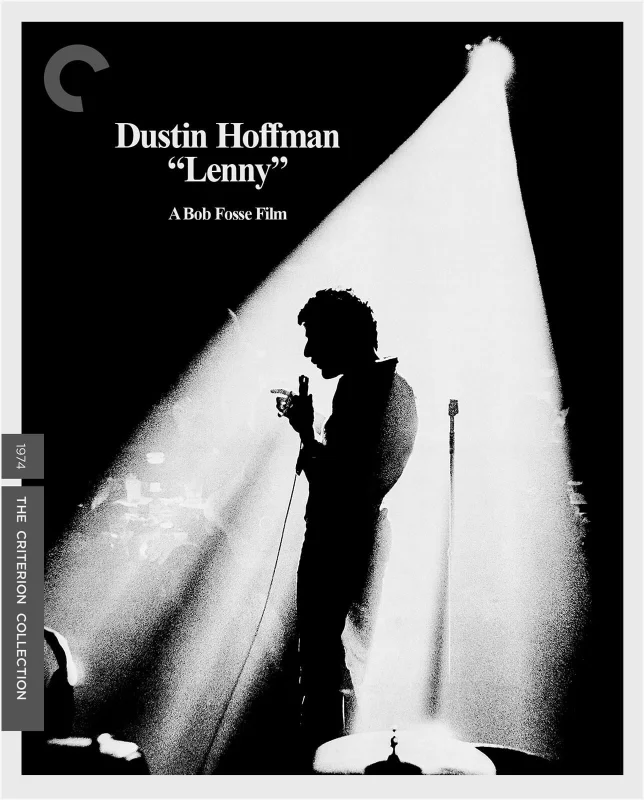
A man with an impeccable sense of taste, proportion, and rhythm—Bob Fosse—didn’t direct many films—just five in total. But the first four of them have become permanent fixtures on nearly every conceivable list of the best films in cinema history. As a Broadway musical director who entered the film industry at a relatively mature age, he imbued his films with the same rhythmic energy of dance...
In his third directorial effort, Fosse turns to the pioneer of the “stand-up comedy” genre (a humorous genre involving direct dialogue with the audience, which emerged in the 1950s), Lenny Bruce. The filmmaker himself knew firsthand the era of the postwar show business boom; he essentially started out at the same time as Bruce. Therefore, all these behind-the-scenes shenanigans and career upheavals stemmed from an autobiographical perspective and were not, as in other biopics, mere fabrications.
The film is structured as an interview with Lenny’s manager and the satirist’s wife, Hanny (played incomparably by Valerie Perrine). By alternating shots of the comedian’s performances (in which he infused his sketches with biographical facts from his own life) with scenes of everyday reality, the director achieves a narrative of remarkable visual fluidity. The film’s black-and-white color palette was also a successful choice, lending an element of documentary realism to everything unfolding on screen. The erotic scenes are depicted here with magnificent expressiveness; without descending into commercial “nude” content, they serve as the film’s artistic highlight. And in general, when it comes to this film—and indeed all of Fosse’s works—the word “gorgeous” is entirely appropriate! Take, for example, the penultimate scene—Lenny’s performance “high” (in a bathrobe and a single sock), shot as a continuous 20-minute sequence. And the entire film has become a true masterpiece, thanks to the director’s subtle “choreography”!
Dustin Hoffman is a full-fledged co-creator of this film. With steady, deliberate strokes and his entire multifaceted palette of talent, he paints a three-dimensional portrait of a “real person,” complete with all the negative and positive traits of his character. He compels the viewer not to judge his actions one-dimensionally, but to feel—at once—pity, revulsion, and admiration. It is precisely at the end of the film that Hoffman’s signature style—that of a “jittery neurotic”—comes into play, when the judicial system (and, in essence, “public morality” and the state, as its representative) crushes the protagonist so thoroughly that he is forced to seek solace in drugs.
By “getting rid” of people like Lenny Bruce (a comedian who subverted “official culture” and became a voice for society), America would become capable of Vietnam and Watergate...
 Telegram and be the first to know about updates!