Login / Register
Guest
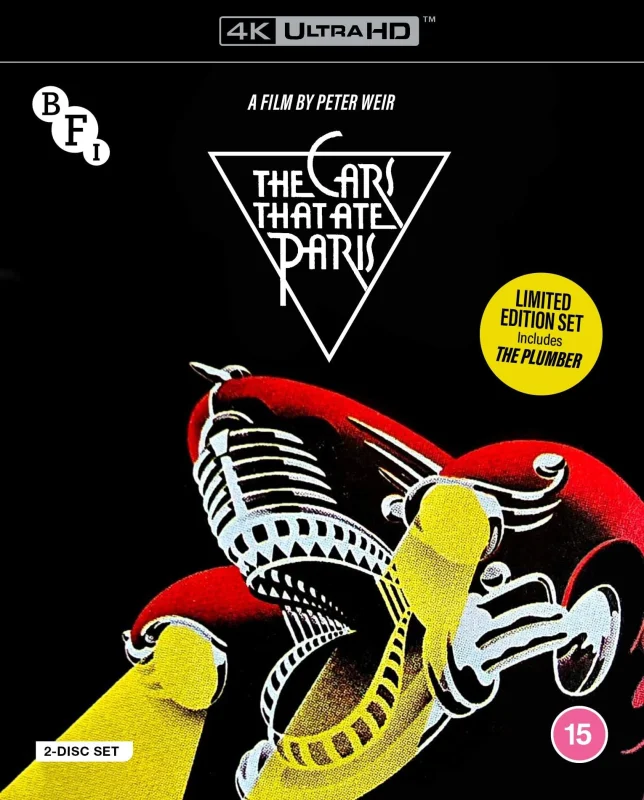
Codec: HEVC / H.265 (94.4 Mb/s)
Resolution: Native 4K (2160p)
HDR: Dolby Vision, HDR10
Original aspect ratio: 2.39:1
#English: FLAC 1.0
#English: FLAC 2.0
#English: DTS-HD Master Audio 5.1
#English: Dolby Digital 2.0 (Commentary by film historian Dr Stephen Morgan)
#English: Dolby Digital 2.0 (The Guardian Interview with director/co-writer Peter Weir)
Australian artists love to periodically remind the rest of the mainland of the desolate, doomed nature of their lands. Marsupial runners, painted Bushmen, and spherical boulders made of branches constantly evoke the apocalypse of the scorching sun and the abandonment of civilization. The urban world is usually charmed by the atmosphere of this untamed wilderness, where humans are regarded as predators on par with, say, a panther or a lizard. Anything is possible on the winding, unpaved roads of the backcountry. But more often than not, car accidents are the result. Bright lights blind drivers on their nighttime journeys, and a heap of metal mingles with human flesh. Perhaps this isn’t a coincidence, but rather a cunning scheme by the residents of a tiny town with the proud name of Paris. Without the Eiffel Tower or croissants, but with hats everywhere and wooden buildings. It’s just like a village from a classic Western, only instead of horses, there are iron horses.
The Western atmosphere smoothly transitions into a thriller when Arthur—a slacker and a whiner tormented by guilt over his brother’s death in an accident—survives one of the traffic incidents. The mayor of Paris takes Arthur under his wing. And here the plot undergoes another transformation, this time toward a Kafkaesque nightmare. No one allows the unfortunate survivor to leave the town, whose small population acts in unison—both in acts of kindness and in acts of cruelty. You have to watch until the end, until the spectacular finale, to better understand the film’s title. The director’s aesthetic vision boils down to horror, to Karmann-style horror films, in which a small budget is compensated for by imagination and an original approach. The near-literal devouring of frail Paris—with its frail moral foundations—by unusual hybrid vehicles, whose menacing appearance evokes the aliens from “open space,” is one of the most stylish scenes in Australian cinema.
"The Cars That Ate Paris" was filmed before Peter Weir’s Hollywood fame and before his own masterpiece "Picnic at Hanging Rock", which gives it the character of a rehearsal within the context of the director’s body of work. The themes and ideas presented in this underrated genre blend (largely for the sake of visual flair) would later expand into a worldview-defining vision. Yet even this early work, slightly naive in its conception, is ambitious in its execution. The juxtaposition of the absurd backwater with the romantic capital of Europe is more brazen than ironic. The plot is completely devoid of any romantic subplot, and the female characters are relegated to the sidelines.
With each subsequent film, Weir would increasingly tell stories centered on character development and conflict, but here the screenplay focuses on other details. The Pioneers—puppets—along with random “guests,” are lost in the details of situational delirium. The director paints “Arthur’s nightmare,” imbuing it with taste and smell. As a result, the magic of the surreal space naturally flows into a horror film—yet another battle between good and evil that leaves ruins in its wake. With his imaginary Paris, Peter Weir seems to speak for all Australian filmmakers who continue to dream, despite the continent’s isolation. Today, Australia has surpassed many countries in the quality of its film industry, but it was once sustained by enthusiasts like Weir and was conceived by a “progressive” community as a set-piece spectacle with a fake name, fake people, and fake monsters. But talent is talent—the ability to build a tangible reality out of sets, to breathe life into mannequins, to create a monster from scrap materials. And Paris… it’s still Paris, even in the desert. A city is a city. A word is a word.
 Telegram and be the first to know about updates!
 [/xfnotgiven_poster]
 [/xfnotgiven_poster]