Login / Register
Guest
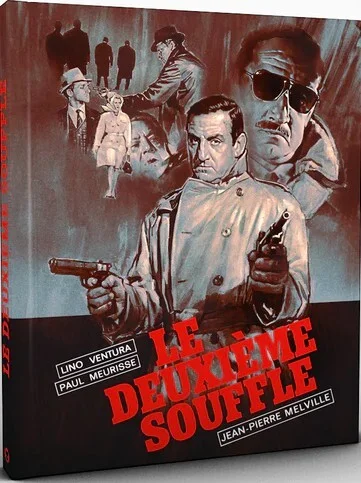
Codec: HEVC / H.265 (80.7 Mb/s)
Resolution: 4K (2160p)
HDR: Dolby Vision, HDR10
Aspect ratio: 1.66:1
Original aspect ratio: 1.66:1
#French: Dolby Digital 1.0
#French: Dolby Digital 1.0 (Commentary by film scholar Ginette Vincendeau, author of Jean-Pierre Melville: An American in Paris, and film critic Geoff Andrew of the British Film Institute)
A film adaptation of a detective novel by the famous French writer José Giovanni. Directed by Jean-Pierre Melville. The notorious thief Gustave Minda (Lino Ventura), nicknamed “Gus,” escapes from a nearby prison and decides to pull off a major heist, hoping to flee the country soon. The only thing keeping the aging gangster in France is the woman he loves, Manouche (Christine Fabrega), who risks her own well-being for his sake. On Gus’s trail is the charismatic Inspector Blo (Paul Meurisse), whose methods don’t command much respect but are also beyond reproach.
“Le deuxième souffle” is one of those films about which there’s not much to say—everything is so simple that you simply have to see it for yourself. The screenplay lacks a backstory, as if torn from a large book whose remaining pages have been lost forever. Only scattered phrases and subtle hints gradually paint a picture of the characters’ interactions and their relationships with one another. This is precisely why it’s very difficult to predict the plot twists, especially since even the characters’ personalities are revealed only as the story approaches its climax. And this is despite the film’s quite classical narrative style, in which the entire action is presented to the viewer as if from the outside, in separate episodes, but strictly according to the “here and now” principle.
The film is notable for the texture and naturalism of its characters, interwoven with deliberate plot contrivances; in this way, Melville—who closely followed the source material—seems to have imbued the film with a certain “literary quality.” The protagonist, initially taciturn and unprincipled, seems to grow closer to the viewer with each new scene, as the motives behind this old-school gangster’s actions are revealed. Gus’s opponent, Investigator Blo, on the other hand, appears to the viewer from the outset as an open book. Blo has nothing to hide, for he is an honest cop—toward the middle of the narrative, this mask will fall, bringing to mind the film’s half-forgotten epigraph. Although, in essence, Melville’s creation is filmed in such a way that one can sympathize with almost every character—whomever one feels a kinship with—while the outright scoundrels can be counted on one hand. Even Manouche, whose character is revealed most consistently, comes across more as a victim of her emotions and circumstances than as a femme fatale from the volatile criminal underworld. A world where a sincere handshake can be followed by a bloody massacre, where some live by a code of honor while others choose the fate of vile rats—a rotten world where words no longer mean anything.
And even if a seasoned movie buff can intuitively sense the likely plot of the denouement, the film is still capable of drawing you in, just like a good novel. “Con” José Giovanni, who went from facing the guillotine to winning literary awards, was intimately familiar with the criminal underworld; he knew where to embellish, what to leave out, and what to show as it is. Almost every one of his books was a success and was adapted for the screen (later, José himself tried his hand at directing). His extraordinary talent as a writer, combined with masterful direction, gave the world a remarkable cinematic detective story, even if it has now acquired a thin layer of mustiness. There is no deep subtext, no social commentary—the film is purely niche, but within its niche, it certainly holds a prominent place.
 Telegram and be the first to know about updates!