Login / Register
Guest
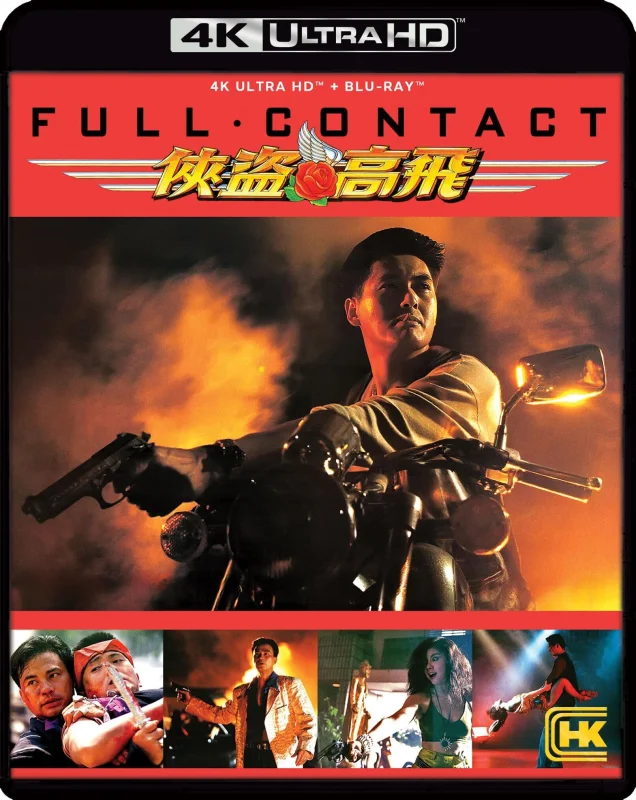
Codec: HEVC / H.265 (86.9 Mb/s)
Resolution: Native 4K (2160p)
HDR: Dolby Vision, HDR10
Aspect ratio: 1.85:1
Original aspect ratio: 1.85:1
#Cantonese: FLAC 2.0
#Cantonese: FLAC 2.0
#English: DTS-HD Master Audio 2.0
#English: DTS-HD Master Audio 2.0
I first watched this movie a few years before writing this review. I was already familiar with Hong Kong, but only superficially. I hadn’t yet explored the works of John Woo, Corey Yuen, Sammo Hung, or other iconic directors in depth, and I certainly hadn’t heard anything at all about Ringo Lam. I was just looking for a movie starring someone with the same name as Jerry Trimbull, and by accident, instead of an American action flick, I ended up watching this Hong Kong all-arounder.
I have to say, I appreciated how unconventional the film was. The unassuming Chow Yun-fat looked awkward compared to the Asian action heroes I was already familiar with, but he shone with extraordinary charisma. The action was unlike either the clumsiness of Western films or the flamboyance of Eastern ones. But what I remember most of all is the atmosphere, which I’d never encountered anywhere else before. Half of the scenes unfold against a backdrop of twilight. Years later, it turned out that Ringo had drawn inspiration from Wong Kar-wai’s filming style. They say Wong Kar-wai himself borrowed the technique from his senior colleague Patrick Tam. However, that needs to be verified… But it doesn’t matter who came up with the idea of refracting light; what matters is that it’s brilliant. The light’s gentle touch on the dark space creates a feeling I’d call “cool coziness.” A serene high that the director infects the viewer with. On the one hand, I’m a proponent of constantly seeking out fresh ideas; on the other, I’d like this style of cinematography to become a permanent fixture of laid-back cinema.
For all its charming unconventionality, I didn’t like the film. Later, I watched other films by Lam from time to time, becoming increasingly convinced that he is a solid director but a mediocre screenwriter (fortunately, the screenplay for this film was written by Yin Nam, the author of the powerful dramatic story *The Indomitable*). When Lam died, I decided to rewatch that very action film that I hadn’t been able to stomach back then, though it had left a vivid memory of raindrops on the blade of a balisong. In the end, the film went down easily and pleasantly, like a summer bike ride. A question arose: this is a great action movie, so why didn’t it click with me back then? It didn’t click because it was a different time—a different era. Like most viewers, I grew up on American action movies, which imprinted a series of clichés in my subconscious that insistently demand constant revisiting. And while the moderately exotic *Evil for Good* or *Hard-Boiled* at least partially satisfied this need through familiar clichés, *Full Contact* throws viewers into confusion from the very first minutes with its deliberate originality.
In short, it’s a good movie, but there’s no rush to watch it. Like its compatriot from the same era, *The Banquet*, *Full Contact* is a film for connoisseurs who’ve devoured a hundred good Hong Kong movies and two hundred bad ones. Watching it right after action movies like *Roadside Diner* is like shoving scrambled eggs and bacon into your mouth before you’ve even had a chance to swallow a piece of chocolate cake.
 Telegram and be the first to know about updates!