Login / Register
Guest
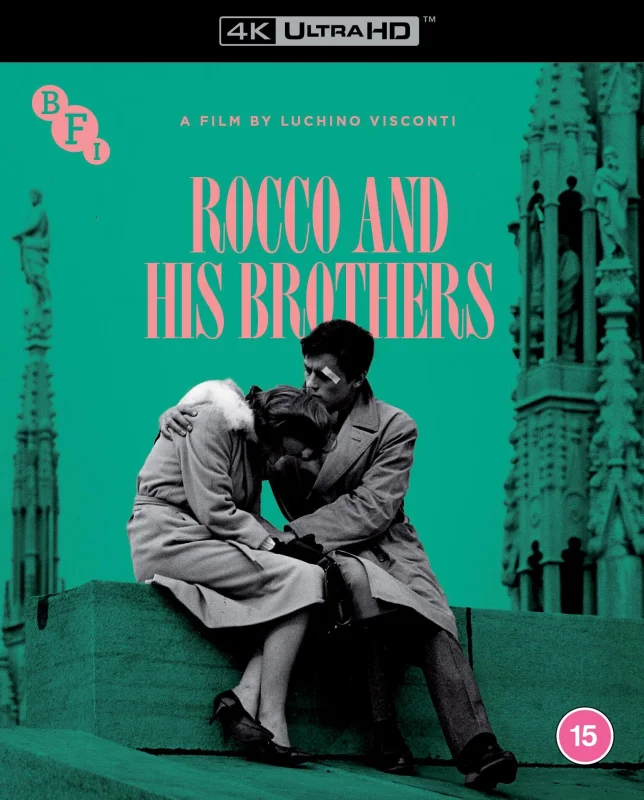
Codec: HEVC / H.265 (68.9 Mb/s)
Resolution: Native 4K (2160p)
HDR: Dolby Vision, HDR10
Aspect ratio: 1.85:1
Original aspect ratio: 1.85:1
#Italian: FLAC 1.0
#French: FLAC 1.0
Any discerning lover of film and literature will recognize in this film the roots of neorealism, with its slums and poverty; the grandeur of Thomas Mann’s novels; and allusions to Dostoevsky’s novels, such as “The Idiot.” Added to this is the Bible, with Cain and Abel, Christ’s sacrifice, and the loss of Paradise... With this deck of cards, Luchino Visconti begins to play with the audience.
The story consists of five chapters, each devoted to one of the Parondi brothers, which show how each of them breaks away from the family—a process typically marked by the emergence of romantic relationships. First, Vincenzo starts his own family and fades into the background; by the end, Ciro also finds love. The only exception here is the youngest brother—Luca—but his character symbolizes both hopes for the future and the director himself, who, like a witness to the events, will tell us this story.
The conflict arises from a love triangle involving Rocco, Nadia, and Simone. Simone falls in love with Nadia and becomes dependent on her; when their relationship ends, he begins to rot from the inside until he crosses the line into absolute moral depravity, after which the “prodigal son returns home.”
Rocco is a saint. Ciro says this outright, and right at the beginning there’s a moment where Rocco gives oranges as a gift—and any art lover will tell you that oranges are depicted only in Paradise or a similar realm. Rocco gives Nadia—however ironic it may be—the hope of starting a new life. And he also tries to save Simone, sacrificing both himself—by taking up the boxing he hates—and Nadia, by pushing her into Simone’s arms.
As the film shows, for these two extremes—Rocco and Simone, whose intentions stem solely from the heart—one for the better, the other for the worse—the outcome is the same: unhappiness. It seems that only Ciro is happy—that is, the one who stands in the middle, the one who is neither a great sinner nor a saint equal to the apostles, but an ordinary person who relies on reason without forgetting the heart.
 Telegram and be the first to know about updates!
 [/xfnotgiven_poster]