Login / Register
Guest
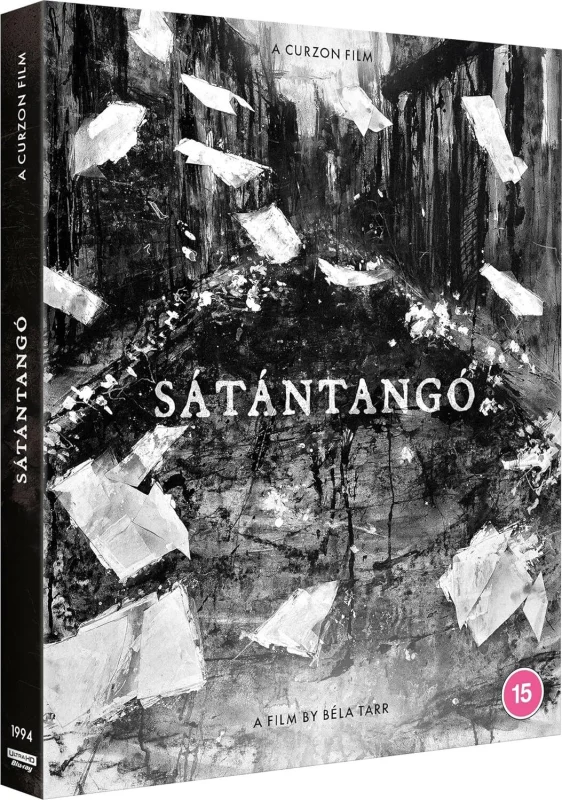
Codec: HEVC / H.265 (78.5 Mb/s)
Resolution: Native 4K (2160p)
Aspect ratio: 1.66:1
Original aspect ratio: 1.66:1
#Hungarian: FLAC 1.0
There’s mud everywhere. The wind blows through the dilapidated houses. The cows go out for their morning walk...
People who drink themselves into a stupor, betray one another, and are mired in routine live in this God-forsaken place. But one morning, the mystical tolling of a bell will disrupt the dreary existence of the decaying collective farm. That would be fine, but the fact is that there isn’t a single bell tower within 50 kilometers. Following this sign, a rumor spreads throughout the collective farm that Irimiash—who disappeared and was presumed dead a year and a half ago—is returning. All these events disrupt the plans of several members of the commune who had gathered to steal the communal funds and flee far away from here.
Irimiash and his two henchmen do indeed return, intent on sowing discord among the farmers. They deliver long speeches, urging the collective farm residents to entrust all their money to them, for they have a plan that will ultimately lead to a happy life for everyone. At the same time, several subplots unfold, allowing this sad metaphor for modern, dreary society to be explored more fully—the story of an old man quietly drinking himself to death in his shack and writing down everything he sees out the window, as well as the story of a little girl, ignored by her parents and unsure of where to go.
Just as in real life, ordinary people will believe the eloquent words of false prophets, and the “great exodus” in search of a better life will begin—with a logical and predictable ending. The people have left, leaving filth in their wake. The wind blows through the dilapidated houses. And the cows—there’s no one left to take them out for their morning walk. Everything is almost as it was before, except for a drunken old man boarding up his window, no longer able to bear looking at this world...
Béla Tarr creates his own unique universe on screen, wildly textured and unlike anything else. It is a gloomy, hopeless, rainy world where there is no place for joy or human happiness. The director spits on all cinematic clichés and formulas, developing the stylistic approach he began in his previous film, ‘ The Curse”—for example, if the plot has an old man running out of wine and going to the store to buy more, Tarr shows this journey from start to finish, without any editing and with no mercy for the viewer, bringing the film’s duration as close as possible to real-life time.
By dividing the film into three parts, the Hungarian director shows each action from different perspectives, so that the viewer can see, in every detail, the satanic tango of human passions and vices...
 Telegram and be the first to know about updates!