Login / Register
Guest
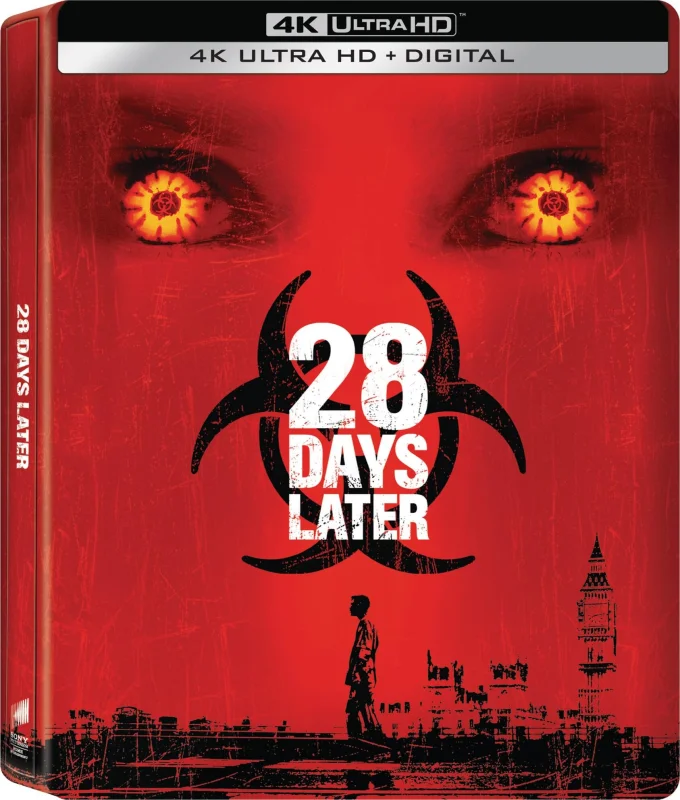
Codec: HEVC / H.265 (64.8 Mb/s)
Resolution: 4K (2160p)
HDR: Dolby Vision, HDR10
Aspect ratio: 1.85:1
Original aspect ratio: 1.85:1
#English: Dolby TrueHD with Dolby Atmos 7.1 (48kHz, 24-bit)
#English: DTS-HD Master Audio 5.1 (48kHz, 16-bit)
#English: Dolby Digital 5.1
#French: DTS-HD Master Audio 5.1 (48kHz, 16-bit)
#German: DTS-HD Master Audio 5.1 (48kHz, 16-bit)
#Italian: DTS-HD Master Audio 5.1 (48kHz, 16-bit)
#Spanish: DTS-HD Master Audio 5.1 (48kHz, 16-bit)
#Spanish (Latino): Dolby Digital 5.1
#Turkish: Dolby Digital 2.0
“28 Days Later...” is, first and foremost, a human drama masterfully disguised and cloaked in the horror-thriller genre.
As I begin writing about this film, I first want to highlight its exceptionally high-quality and beautiful visuals. Every frame and scene looks very vivid and cohesive. And I’m sure the views of a London ravaged by fear—mesmerizing in their emptiness and silence—have left a lasting impression on many viewers. I must also praise John Murphy, who composed the excellent score featured in the film.
It’s also impossible not to mention the well-structured plot, which alternately accelerates and slows down the narrative. Moreover, the plot greatly aids in the development of the characters, who are portrayed with great clarity by talented actors. The young man Jim, who matures and grows braver right before our eyes over the course of the film, is played with selfless dedication by rising star Cillian Murphy.
Naomi Harris, who three years later would play a flamboyant sorceress in the “Pirates of the Caribbean” sequels, delivers a quite convincing performance as Selene, a brave, sharp-tongued, yet deeply human warrior.
Brendan Gleeson brings great vitality and heart to the role of a father who loves his intelligent and mature-beyond-her-years daughter—played by Megan Burns—with all his heart.
The film is often described as atmospheric because it is renowned precisely for its spirit and sense of hopelessness. Moreover, this hopelessness isn’t limited to the end of the world and the inevitability of death. What’s frightening is that even such a monstrous catastrophe not only failed to unite or bring people together but, on the contrary, caused them to fight each other with redoubled intensity. Nothing has changed—and nothing is going to change—in human relationships, as the commander of a small group of soldiers points out. People have always killed one another, and they continue to do so. And it seems there is nothing that can change this. This is precisely the most nightmarish hopelessness of the situation.
Beyond all this, the film explores a serious philosophical theme. The characters, trapped in a dead-end situation, begin to ponder the meaning of life. Moreover, we’re shown not just the filmmakers’ perspective, but how it evolves as the story unfolds. When Jim and Selena meet for the first time, they agree that nothing is more important than this very moment in the present. We must live in the now, because at any moment, all our plans and dreams can go down the drain and suddenly mean absolutely nothing. The value of life. But later, when the characters meet the father and his daughter, they change their convictions. There is something greater than today, something more important than the present moment. There is simply the gift of life and its pricelessness—something we must cherish every second, the very reason we live.
For this entire high-quality blend of genres and ideas, created and brought to life by a diligent and intelligent team led by the brilliant Danny Boyle, I have no hesitation in giving them what they deserve.
 Telegram and be the first to know about updates!
 [/xfnotgiven_poster]