Login / Register
Guest
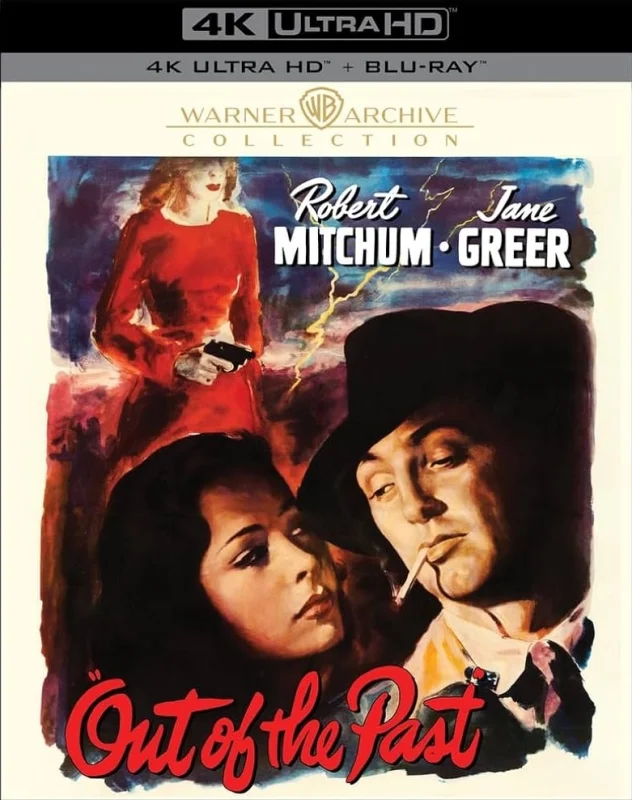
Codec: HEVC / H.265 (80.0 Mb/s)
Resolution: Native 4K (2160p)
HDR: Dolby Vision, HDR10
Aspect ratio: 1.37:1
Original aspect ratio: 1.37:1
#English: FLAC 1.0
#English: Dolby Digital 2.0 (Commentary by Film Historian James Ursini)
Robert Mitchum plays a private investigator who is tasked by an old friend with a most unpleasant job—stealing important documents that compromise the client himself. That would be fine—Mitchum’s no slouch; he’s the kind of guy who gets in and out of trouble with ease—but this tasty side dish from Jacques Turner has long been accompanied by a main course.
Before the main character is neatly set up to take the fall, the viewer will already know who not to trust in this devious story—because there’s no one you can trust. And there’s nothing surprising about that—Jeff (Mitchum’s character) once betrayed a friend himself, running off with his girlfriend to “paradise.” Is it any wonder that the aggrieved party—in this case, a criminal element, no less—suddenly wants to settle the score? After all, as we all know, you have to pay for everything in life. Of course, one could also talk here about the mighty hand of fate or about the past, which, like a boomerang, tends to come back around, but in reality, things aren’t quite so simple in this cult noir from the creator of classic horror films with bizarre titles like “Cat People” and “I Walked Beside a Zombie.”
Much like some grindhouse films, Turner’s masterpiece readily splits into two halves. Which one is better is, of course, up to each viewer to decide. For me, it’s the first one—the one with four bullets in Kirk Douglas’s stomach and forty pieces of stolen “green.” The one with the “story within a story” and the unbearable heat in Acapulco. But if someone prefers the second half—more convoluted and hard-boiled in the noir style, yet painfully contrived with an abundance of hard-to-remember names and plot twists, and always with a 180-degree turn—I wouldn’t be surprised. After all, despite the “cross-section” structure, the narrative integrity remains intact—the second story isn’t possible without the first, just as the first isn’t possible without the second. Only the coordinates of time and space are distorted—everything else remains the same: a gangster turns out to be a gangster, a bitch a bitch, and, well, a good guy—as they say—is a good guy even in Africa.
And Mitchum, of course, is great—where Bogart would have made his way with a pistol and a long, rapid-fire tirade, this bruiser gets by with his fists and Gaben’s cool composure. The noir era was kind to actors of this type, but, like all good things, those days have passed. Maybe it’s time to bring them back into the spotlight?
 Telegram and be the first to know about updates!
 [/xfnotgiven_poster]
 [/xfnotgiven_poster]
 [/xfnotgiven_poster]