Login / Register
Guest
Codec: HEVC / H.265 (91.2 Mb/s)
Resolution: Native 4K (2160p)
HDR: Dolby Vision, HDR10
Original aspect ratio: 1.37:1
#English: FLAC 1.0
#English: Dolby Digital 1.0 (Commentary by filmmaker Martin Scorsese and critic Bruce Eder)
#English: Dolby Digital 2.0 (Commentary by film historians Alain Silver and Jim Ursini)
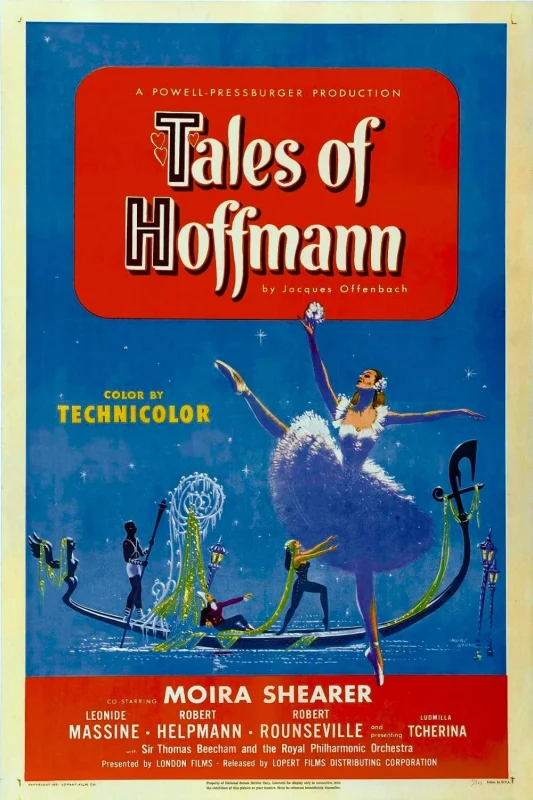
And this opera is, in fact, the only one in the repertoire of French composer Jacques Offenbach. It’s actually called “The Tales of Hoffmann,” oddly enough. If you read the plot of the opera itself and then watch Powell’s masterpiece—or vice versa—you’ll notice a number of changes that the filmmakers introduced into the cinematic fairy tale. But trying to compare two works of art that, by their very nature and definition, exist on different planes—though they may intersect in some places—is a thankless task, especially considering that I haven’t had the chance to see the opera (and probably never will)—so I won’t bother with tedious nitpicking. Instead, I’ll briefly run through the personal impressions left in my mind and short-term memory by watching “The Tales of Hoffmann.” And since my review is the only one so far—and the rating was given solely by me—I need to do this right away: share it.
Once, Michael Powell completely captivated my heart and imagination with his utterly magical “The Red Shoes.” And now, some time later, he’s pulled off the same trick—only several times more powerfully. I don’t know anything about classical music, but who cares when your eyes dart all over the place and then, even when they come back together, you can’t focus or shake off the blur—everything on the screen is so vibrant and bursting with all kinds of colors. No, your eyes don’t close; on the contrary, they widen with delight. I want more! It’s only natural. When, on the other side of the screen, beautiful young women are dancing and singing; when every detail of their costumes is crafted with such care and love; when romantic passions swirl around them, rivaling those of Hoffmann’s tales—what else is left but to squeal with delight inside?
Three love stories, three personas merge into one young woman—the star—Stella. Love for a work of art, for a courtesan, and for a tender young woman—that’s how Hoffmann portrays it. And each has a name. The first, played by my favorite, Moira Shearer, who also plays Stella, is called Olympia. A wind-up doll among her peers, seen by Hoffmann through “rose-colored glasses.” Soon her doll-like image will shatter, and nothing will remain. Just as with feelings. The second love, a truly fatal beauty, is Juliet. Lyudmila Cherina is simply a goddess. She will seduce you and turn you into a shadow without a reflection. And you’ll wander like a ghost through the melancholic streets of Venice if you don’t come to your senses in time… The third is Antonia. A talented singer who chose not to follow love. Nothing but disappointments, yet in reality—nothing but a longing for love, though not from her... These characters, passing from one story to the next and brought to life by the same actors, linger in the mind even days later. And my experience with *The Red Shoes* tells me they won’t let go anytime soon. And I’m actually glad about that.
But the time has come for it to end—and for everyone, that time is different. I’ll say just one thing in conclusion: there will be a path ahead. And hope that everything will be all right. After all, Michael Powell is my favorite storyteller, no matter what he films. No matter what people say about him.
 Telegram and be the first to know about updates!