Login / Register
Guest
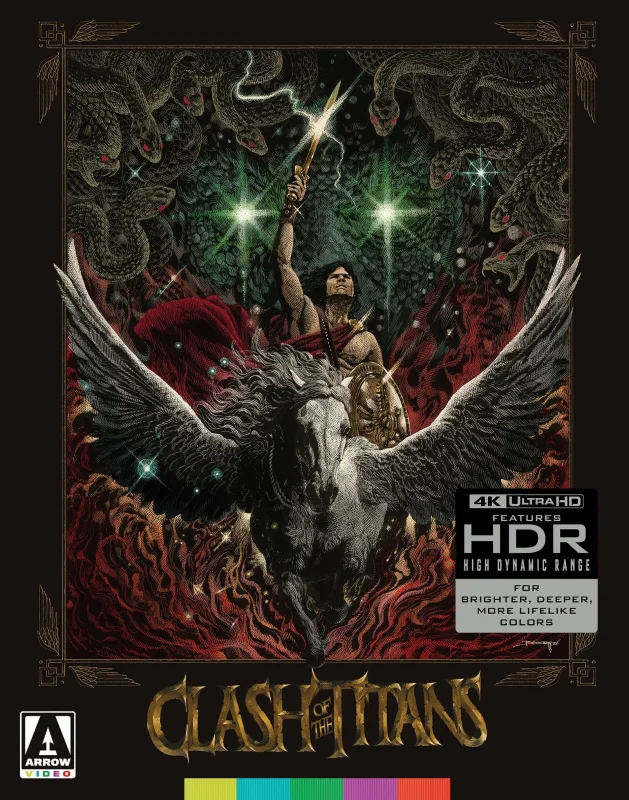
Codec: HEVC / H.265 (92.2 Mb/s)
Resolution: Native 4K (2160p)
HDR: Dolby Vision, HDR10
Original aspect ratio: 1.85:1
#English: FLAC 2.0
#English: Dolby TrueHD with Dolby Atmos 7.1
#English: Dolby Digital 5.1
#English: Dolby Digital 2.0 ("Ray Harryhausen at the BFI", 1981 audio interview conducted after a screening of "Clash of the Titans")
#English: Dolby Digital 2.0 ("Ray Harryhausen & Charles Schneer at the BFI", 1970 audio interview with Ray Harryhausen and his long-time producer Charles Schneer)
In ancient Greek myths, there once lived a man named Perseus. By all accounts, he was supposed to grow up peacefully and rule a typical Greek polis, about half the size of Moldova. But those same myths also featured gods and goddesses—real-life role models: womanizers and shrews, one after another. And they had a blast cuckolding someone, unleashing a kraken (or a “sea monster,” if you will) on someone else, or tossing a super sword and some gear to yet another. Meanwhile, the people down below—including Perseus—had to deal with the fallout, heroically slaying all manner of monsters... This little fairy tale formed the basis of the film nearly thirty years ago.
“Clash of the Titans” didn’t remain particularly popular for long—more spectacular and larger-scale films kept coming out, luring away fans—but a core group of loyal supporters of this epic film remained. They like this film just the way it is, and, in fact, for good reason—the little-known director Desmond Davis managed to create a film with an inner harmony. Yes, it’s laughably primitive in places, but it’s still a pleasure to watch.
Mechanical puppets, several layers of makeup, stop-motion animation, frame-by-frame compositing, and hand-drawn backgrounds in the distance—none of this detracts from this particular film. Here, in *Clash of the Titans*, there’s a true Renaissance of cinematic antiquity—every technique developed before 1980 (except for computer graphics) makes an appearance somewhere. And, no matter how you look at it, the result is a resounding “wow,” even if many hear only a sour “uh-huh.”
There were more than enough roles—both male and female—to cast Laurence Olivier, Maggie Smith, Ursula Andress, and many others less familiar to us. As a talented actor, Lawrence couldn’t have been given a role more majestic and controversial than that of Zeus, the chief god and supreme tyrant of Olympus. Maggie Smith was cast as the sea goddess Thetis (she is the one who causes the most harm to the protagonist, but it’s not that simple, for this is how she takes her revenge on Zeus). As for Perseus, during a decade when most productions focused on youth—starring young actors and, often, directors who were far from old themselves—the ancient Greek hero was cast as a college senior. Harry Hamlin did his best to play the hero, and it would be foolish to blame him for the conceptual vision of the creators of *Clash of the Titans*.
A tense duel with Medusa, who, in addition to her gaze, also fires arrows. Pegasus, the winged horse, whose plumage, naturally, looks a bit off but doesn’t stop him from flying. A leisurely battle with three large (though not quite giant) scorpions. A sea monster that hasn’t been dusted off since the days of *The Creature from the Black Lagoon*. A mechanical owl that simply won’t shut off (despite its comical nature, it saves everyone about three times). Beautiful “Greek goddesses,” the gleaming plastic of their armor, and the white, cloud-like splendor of the Olympian Hall of Fate. Sure, you can nitpick every single aspect of the movie, but here’s the thing: if you don’t look at it head-on but from a side angle, *Clash of the Titans* still holds its own—even 29 years after its epic run in theaters.
 Telegram and be the first to know about updates!