Login / Register
Guest
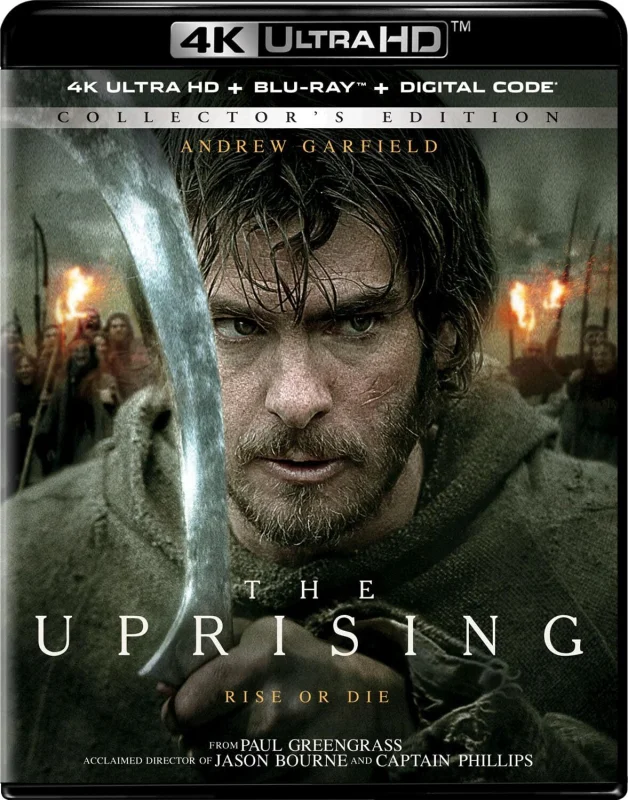
Codec: HEVC / H.265 (83.1 Mb/s)
Resolution: Native 4K (2160p)
HDR: Dolby Vision, HDR10
Aspect ratio: 1.85:1
Original aspect ratio: 1.85:1
#English: Dolby TrueHD with Dolby Atmos 7.1 (48kHz, 24-bit)
#English: Dolby Digital Plus with Dolby Atmos 5.1
#French (Canada): Dolby Digital 5.1
#Spanish (Latino): Dolby Digital 5.1
England, 1381. The country has just survived a plague epidemic that wiped out half the population, but life for ordinary people has not gotten any easier: peasants are exhausted by backbreaking labor and exorbitant taxes. Unrest is sweeping the country. At the head of the rebels is Wat Tyler, who never dreamed of becoming a leader, but it is he who will change the course of history.
I never would have thought that this movie would turn out to be such a dark horse at the box office.
By depicting a 14th-century story, the filmmakers not only extrapolate it to the history of human society as a whole, but also to the present day in particular.
The plague, which claimed countless lives. A state that sends its citizens to fight far away for dubious causes. The exhaustion of the people through backbreaking labor, exorbitant taxes, and other methods to replenish its empty treasury. Sounds familiar, doesn’t it? But that’s not all.
Citizens who disagree with this attempt to revolt (there is simply no other form of dialogue) in order to convey to the king their problems, which they can no longer bear. The king’s advisors, who are supposed to help him, deceive him, mislead him, and impose their will upon him. It is no coincidence that the author chooses this particular historical period: the king is effectively portrayed here as a child, which underscores this figure’s lack of independence, indecisiveness, and cowardice.
But even blood spilled on one’s native soil is not enough to change the world for the common person. Kings, advisors, slogans, and coats of arms come and go, but the mechanisms remain the same. The people will still be ground down by the wheels of the state. And so it will always be. In this film, Greengrass offers no hope for a “bright future” for everyone.
The only thing left to do is to instill in those in power a fear of their own people and somehow try to carry on living.
I think it’s already obvious that we all live in exactly this kind of world today. No matter what flags and coats of arms fly above your head.
Those who remember Greengrass’s “Bourne” films are familiar with his signature style in cinematography and editing. It’s used here as well, and this “documentary-style” approach works brilliantly to immerse the viewer in the action. The film’s setting is merely a superficial shell. Swap out the 14th-century sets and costumes for those of the 21st century, and you wouldn’t have a single question about what’s happening on screen.
How was this movie even allowed to be released anywhere? After all, it speaks to the audience with the utmost honesty, which I can’t help but appreciate. I believe this is one of the most important films of recent years and one of the best films of this year.
Will we live to see change? Is it even possible to change anything?
 Telegram and be the first to know about updates!