Login / Register
Guest
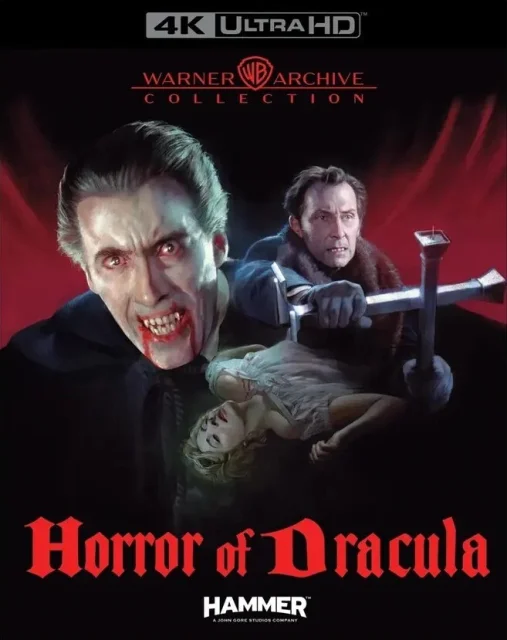
Codec: HEVC / H.265 (64.5 Mb/s)
Resolution: Native 4K (2160p)
HDR: Dolby Vision, HDR10
Aspect ratio: 1.66:1, 1.85:1
Original aspect ratio: 1.75:1
#English: DTS-HD Master Audio 2.0
#English: DTS-HD Master Audio 5.1

Terence Fisher’s *Dracula*, in my opinion, is a one-of-a-kind film. It’s so different from all the other films about the bloodthirsty count based on Bram Stoker’s novel that I’ve seen so far. Even if you’ve read Stoker’s original novel or watched a bunch of its film adaptations, but haven’t seen Fisher’s film —you’ve missed out on a lot, because Hammer Films’ *Dracula* surprises with both its original take on Stoker’s work and the plot’s utter unpredictability, which is a rarity for horror films of the 1950s.
It’s refreshing that the film doesn’t drag on with a long build-up. The film begins abruptly, without any unnecessary preamble. Jonathan Harker, posing as a librarian, infiltrates Count Dracula’s castle and gains the count’s trust. But after some time, news of him stops reaching his hometown, and Dr. Van Helsing sets out in search of the missing Harker... The plot setup is highly original and grabs the viewer’s attention from the very first minutes. Throughout the film, there are plenty more plot twists in the spirit of the best detective stories. They may seem naive by today’s standards, but they’re still worth appreciating in the context of that era.
The film is beautifully shot, on a grand scale, yet quite restrained and staid—exactly what one would expect from classic English cinema. Dracula’s castle was a very pleasant surprise. It’s so unlike the gothic, medieval, and gloomy mansions that still dominate vampire-themed films today. The Count’s residence in Fisher’s film looks very cozy and warm. But even more surprising is the host himself—Count Dracula. At first glance, he appears to be a well-mannered English gentleman who’s pleasant to talk to—so unlike the traditional monster that Dracula is usually portrayed as. The legendary Christopher Lee brought this role to life magnificently. Unfortunately, he didn’t appear in the film as much as I would have liked. I especially remember his crooked, forced smile, revealing sharp fangs. He turned out to be a very charismatic character.
Peter Cushing played the role of Dr. Van Helsing. Like Lee, he did an excellent job. But Carol Marsh (Lucy) was the most impressive. She was the only one who managed to scare me a little. Her encounter with her brother in the cemetery was both very eerie and tragic. The finale was very spectacular. Modern special effects creators could learn a thing or two from it. Even though the film is more than half a century old, it still manages to impress viewers who are spoiled by modern computer graphics. The only thing I didn’t like about Fisher’s film was the music. In my opinion, it’s too grandiose, too oppressive. But this minor detail can’t overshadow the experience of watching this magnificent film from Hammer Studios’ classic horror series.
 Telegram and be the first to know about updates!