Login / Register
Guest
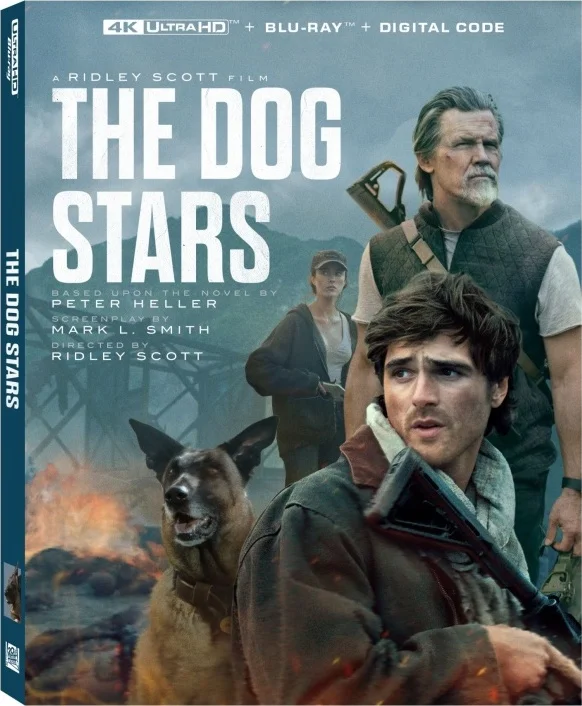
Codec: HEVC / H.265 (48.1 Mb/s)
Resolution: Native 4K (2160p)
HDR: Dolby Vision, HDR10+
Aspect ratio: 2.39:1
Original aspect ratio: 2.39:1
#English: Dolby TrueHD with Dolby Atmos 7.1 (48kHz, 24-bit)
#English: Dolby Digital Plus with Dolby Atmos 5.1
#French: Dolby Digital Plus 7.1
#French: Dolby Digital Plus 7.1
#Spanish: DTS 5.1
#Spanish (Latino): Dolby Digital Plus 7.1
#German: Dolby Digital Plus 7.1
#Italian: Dolby Digital Plus 7.1
#Japanese: Dolby Digital Plus 7.1
When I think about the apocalypse in one form or another, what I feel most sorry for are the achievements of civilization. Not technological achievements, but above all the achievements of science and art. You watch an interview with some mullah from Saudi Arabia who, with a straight face, tries to prove that the Earth is flat because… (followed, of course, by religious tenets), and you shudder to think what would become of human science if power fell into the hands of such obscurantists.
There are plenty of post-apocalyptic movies. The most powerful one is probably *The Road* (2009). There’s *28 Days Later*, there’s *A Quiet Place*—in short, a whole bunch. Hundreds, if not thousands. And they all have one thing in common. The remnants of humanity, despite the horrific conditions of their existence, still struggle to survive, try to establish contact with one another (almost always with negative results), and reproduce. In principle, there’s a theory that our civilization is far from the first on Earth. We’ve wiped each other out completely more than once, and the remaining survivors have started over from scratch, only to end up just like their predecessors.
I don’t know how true that is, but my personal opinion is: if we’re going to die out, so be it. If we can’t achieve a high level of self-awareness even with an advanced civilization, then what can we expect from a primitive one? Make way for those who are kinder, wiser, and who won’t turn the planet into a dumpster.
Actually, Ridley Scott’s new film is about this. The main characters in *The Dog Stars* don’t survive—they merely linger on. After a deadly epidemic, only a handful of people remain, living in scattered groups and showing little desire to join forces, because everyone understands that there’s nothing good to expect from other people. This is especially true for Josh Brolin’s character, an aging veteran who sees an enemy in every stranger. His partner, Hig, however, still has dreams. He dreams that somewhere out there, something remains. The main thing is to find it. He does find something, but it’s not at all what he expected.
And although Ridley Scott does try to inject some hope at the end, his film reveals one simple truth: people can’t be changed.
All in all, I’m glad that giants like Scott continue to make movies. Going to the theater to see their films is always a treat for the soul. You forget where you are, who you are, and simply live in the world and story presented to you—even if there are some holes and inaccuracies in it.
 Telegram and be the first to know about updates!