Login / Register
Guest
Codec: HEVC / H.265 (91.1 Mb/s)
Resolution: Native 4K (2160p)
HDR: HDR10
Aspect ratio: 1.85:1
Original aspect ratio: 1.85:1
#Japanese: FLAC 2.0
#Japanese: DTS-HD Master Audio 5.1
#English: Dolby Digital 2.0 (Commentary by horror cinema writer Amber T)
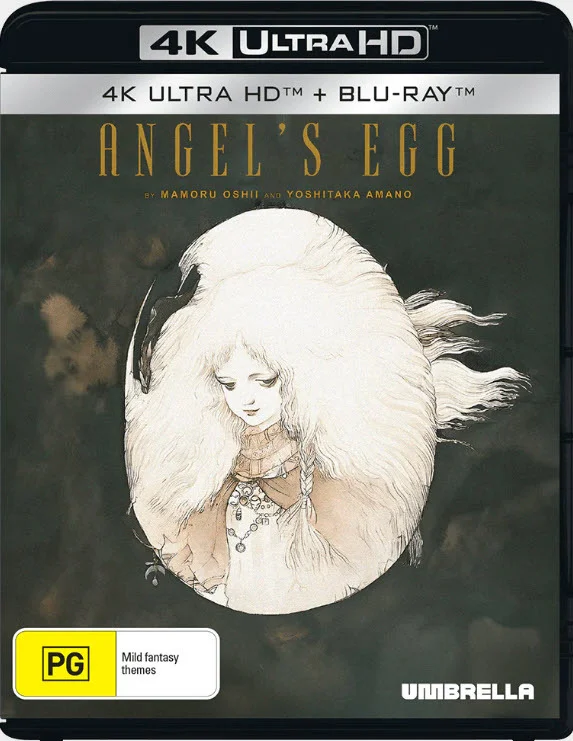
Mamoru came up with a world abandoned by God. And the movie Angel's Egg is an exposition of this world. In fact, it is a film-painting, so it needs neither a plot nor any other meaning except for viewing the canvas (i.e., the invented world). The puzzle consists of organizing all the visible elements into a system as much as possible. The meaning is to stay in this realm of the “dead” and experience something.
It is a dead world after the flood, devoid of life force and goodwill. It consists of abandoned cities, bones, shadows of people, and shadows of animals. The shadows of people hunt the shadows of animals. The remains of weapons, seemingly devoid of drivers, crawl around the world. The world is covered in gloom. And on a large hill stands an ark that apparently saved no one. The last “living” (whether they are alive is unclear) are oppressed and live in this realm of shadows without meaning or purpose.
In places, there is pronounced expressionism. In places, it is ordinary anime. In places, there are completely amazing surrealistic shots: for example, when giant shadows of fish swim into the city, these shadows flow along the pavement and the walls of houses.
Two storylines emerge as the plot unfolds, with two agents fighting each other. The first storyline is about one of the last ‘living’ people, a girl who walks through dead cities and carries a bird's egg with her. According to legend, a new bearer of light should hatch from the egg. The very ‘warmth’ that left the world. With this bird, ‘light’ can come into the world. It doesn't matter if the egg is alive, what matters is that someone else carries hope in this world. The opposing agent is a demonic ship that searches the entire planet for the last hopefuls. Upon finding one, the demon sends his servant, who in one way or another takes away the hope of the living, after which another sculpture appears on the side of the ship, depicting the fallen hopeful.
Osamu Mamoru does not explicitly refer to God, but the context points to Christian elements: the flood, the ark, the bird (sent by Noah), the angel's egg. However, there are no references to alternative religions, except for Stonehenge-like stones in the fields. A direct reference to abandonment is found in the Mamoru world legend. In Christian legend, Noah sends a dove from the ark several times, which finally returns with an olive branch, indicating that the water has begun to recede. This branch is a symbol sent from God of the restoration of peace, of God's reconciliation with man (hence the expression ‘dove of peace’). Mamoru's legend borrows all the elements of the Christian legend, but says that the bird did not return: there can be no reconciliation with God. In this world, there is only an agent of despair, collecting destroyed agents of hope.
The film does not yet feature Mamoru's favorite approach - hidden contemplation. It appears a little later. The film is difficult to understand, so it's worth watching a couple of times. To be honest, the vivid, mystically hopeless post-apocalypse does not oppress, but literally makes you cling to your hope - to rejoice that my world is not Mamoru's world.
 Telegram and be the first to know about updates!
 [/xfnotgiven_poster]