Login / Register
Guest
Codec: HEVC / H.265 (58.4 Mb/s)
Resolution: Upscaled 4K (2160p)
HDR: Dolby Vision, HDR10
Aspect ratio: 2.39:1
Original aspect ratio: 2.39:1
#English: Dolby TrueHD with Dolby Atmos 7.1
#English: Dolby Digital 5.1
#French: Dolby Digital 5.1
#French: DTS 5.1
#Danish: DTS 5.1
#Dutch: DTS 5.1
#Finnish: DTS 5.1
#Norwegian: DTS 5.1
#Portuguese: Dolby Digital 5.1
#Swedish: DTS 5.1
#Spanish (Latino): Dolby Digital 5.1
#Spanish: DTS 5.1
#Arabic: Dolby Digital 5.1
#Bulgarian: Dolby Digital 5.1
#Croatian: Dolby Digital 5.1
#Czech: Dolby Digital 5.1
#Hindi: Dolby Digital 5.1
#Hungarian: Dolby Digital 5.1
#Serbian: Dolby Digital 5.1
#Slovak: Dolby Digital 5.1
#Slovenian: Dolby Digital 5.1
#Tamil: Dolby Digital 5.1
#Telugu: Dolby Digital 5.1
#Turkish: Dolby Digital 5.1
#Japanese: DTS 5.1
#Russian: DTS 5.1
#Estonian: Dolby Digital 5.1
#Greek: Dolby Digital 5.1
#Hebrew: Dolby Digital 5.1
#Icelandic: Dolby Digital 5.1
#Latvian: Dolby Digital 5.1
#Lithuanian: Dolby Digital 5.1
#Polish: Dolby Digital 5.1
#Romanian: Dolby Digital 5.1
#Ukrainian: Dolby Digital 5.1
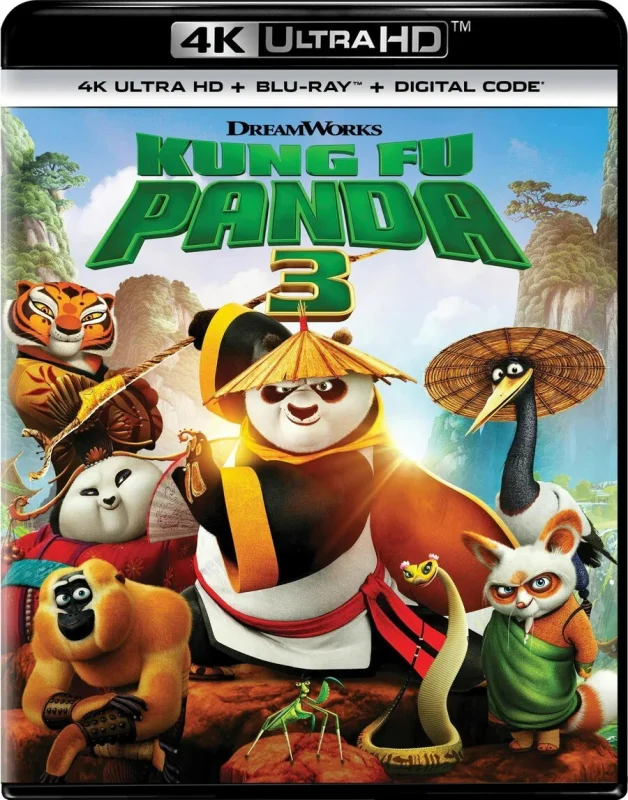
After Master Shifu decides to retire, Po the panda must take on a new role for himself—that of kung fu teacher. He's not very good at it, and besides, he has more important things to do—Po finds his real father and goes with him to a distant panda settlement. At this time, his native village is attacked by Kai, a warrior who has returned from the spirit world—he wants to remain the only warrior in China, enslaving everyone else and taking their chi energy.
If Kung Fu Panda is back on the big screen, it means someone wants it. The furry martial arts hero was first introduced to audiences by DreamWorks Animation in 2008 and received an Oscar nomination. The sequel was also highly praised and included in the list of the best animated films of 2011, but what is more important is how much money the franchise brought to its creators - with a total budget of $280 million, the two films grossed nearly $1.5 billion at the box office. Unsurprisingly, there are rumours of six stories about Po's adventures in the pipeline - we are only halfway there.
The ‘recipe’ hasn't changed at all - it's still the same children's fairy tale with a deliberate moral about the importance of being yourself and the significance of family in life. Whereas previously the creators of Kung Fu Panda played on the differences between Po and his adoptive father, now they have found a new angle: the main character finds himself among his own kind, but he was raised by birds, so he has to learn everything from scratch. There is a hint of the contrasts between the traditions of different peoples, but it is not developed properly, while the idea that family is not necessarily a blood relationship is once again a recurring theme.
One might expect to be turned off by the didactic tone, but here it is clear that the film was made by people who know what they are doing: the screenwriting duo of Aibel and Berger is back, and Jennifer Yuh, who worked on the second Kung Fu Panda, remains in the director's chair. And the vivid visuals allow you to distract yourself from the moralizing—the overly “correct” dialogues are skillfully interspersed with spectacular fight scenes that will absolutely delight the target audience. There is also plenty of gentle, good-natured humor here—no satire, no cynicism, everything is sanitized and sterile, but those are the rules.
Many modern cartoons are aimed at audiences of different ages, but Kung Fu Panda works exclusively in one direction: it is a babysitter for children, and adults, leaving them with it, can do something else. There is no need to worry: the little ones will not be allowed to get distracted, they will not be bored, and everyone will be happy. The third installment of the franchise does its main job perfectly, and we didn't expect anything else from it. Sometimes consistency is a very good thing.
 Telegram and be the first to know about updates!