Login / Register
Guest
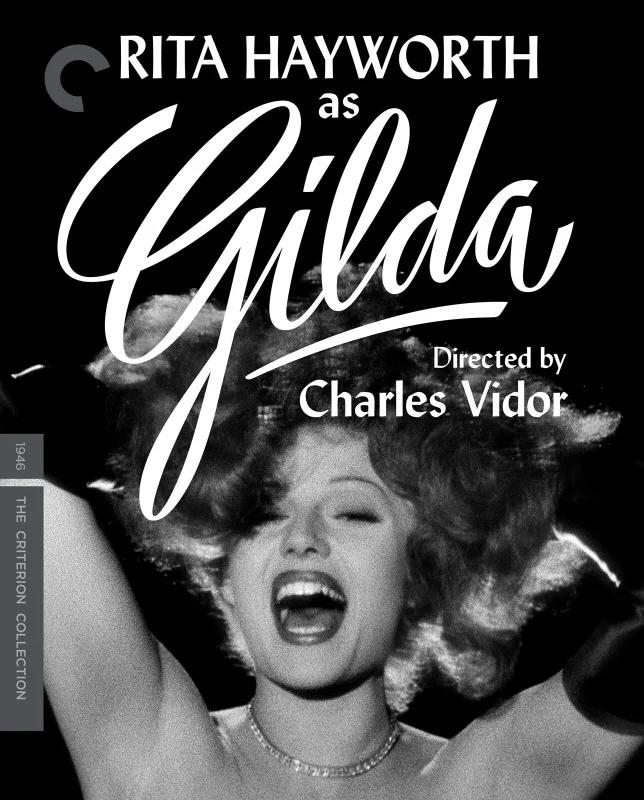
Codec: HEVC / H.265 (94.1 Mb/s)
Resolution: Native 4K (2160p)
HDR: Dolby Vision, HDR10
Aspect ratio: 1.37:1
Original aspect ratio: 1.37:1
#English: FLAC 1.0
#English: Dolby Digital 1.0 (Commentary by film critic Richard Schickel)
The femme fatale Gilda playfully turns the heads of two men—her own husband and her former lover. It’s no sin to lose your head over a woman like her, and the men, in pursuit of her elusive beauty, are ready to kill each other. Such is the premise of this classic film noir. To be more precise, this is its widely accepted interpretation. In this very interpretation, Gilda is a priori cast as a ruthless and unscrupulous vixen (just as Holly Golightly from *Breakfast at Tiffany’s* is a priori cast as a glamorous, carefree socialite). But in reality, Holly is a bundle of nerves and insecurities, and only later does she become a style icon and all that. But interpretation is a powerful thing. Not even interpretation, but a sort of variation on an old joke: “Why is everyone praising this Caruso so much? He sings terribly! – Have you heard him? – No, Petka sang it to me.”
Just like that, someone once claimed that Gilda was a femme fatale without shame or conscience, luring gullible men into her web and taking pleasure in watching the poor souls struggle to escape her sweet trap. And we believed it. Don’t believe it, comrades. In reality, the only things “fatal” about Gilda were her lion’s mane of curls and the song “Put the Blame on Mame.” I’ll have more to say about the song later, but for now I’ll note that in every other respect, Gilda was an unhappy woman, suffering because her beloved Johnny turned out to be such a scoundrel. But can a woman like that really suffer? No, that’s not right. Can SUCH a woman really suffer?
Looking at the classic poster for “Gilda,” on which the beautiful Rita Hayworth is frozen with a cigarette in her hand and a sly smile on her lips, my heart flatly refused to believe that such a woman could simply suffer. Do goddesses suffer? That’s why the classic image of Gilda is that of a ruthless femme fatale. But in reality, I’ll say it again, Gilda was a character who suffered agonizingly, incomprehensibly. Partly because of her “femme fatale” nature (if anyone knows another way to describe it—let me know). Well, is she to blame for being so beautiful and unforgettable? Is she to blame, again, for the fact that her beloved didn’t understand her? Is she to blame for the fact that her husband adored her to the death, while she didn’t seem to feel the same way about him? The scene in which a tormented Gilda, with tears in her eyes, throws herself at Johnny’s feet on her knees has surely broken the heart of more than one movie lover. At the sight of such beautiful, “wounded” eyes, Hitchcock would have forgotten all his blondes—because Gilda alone would have embodied all his dreams. The perfect victim, lonely and touching—that is who Gilda was “in real life,” and in the collective consciousness, which was not overwhelmed by the beauty of actress Hayworth.
But beauty, as we know, is a terrible power. That’s why Gilda will have to come to terms with the label of “femme fatale.” Although, honestly, how does our Gilda compare to Rosalie, played by the same Hayworth in *The Lady from Shanghai*? Now that’s a femme fatale, now that’s intrigue and ruthlessness! Compared to her, Gilda is a white lily. In short, “Gilda” is a classic example of how myths are created. The story of the beautiful Gilda, slightly entangled in her relationships and suffering from this very uncertainty herself, went down in cinema history as a classic film noir drama about a beautiful and cruel woman and the men helpless in her face. Although, in reality—I’ll say it again—all Gilda really wanted was simple happiness. Well, in principle, that’s fine. Especially since the title of “femme fatale” suited Rita Hayworth like no one else in this life.
The film is essentially a showcase for this magnificent actress, who demonstrated in this film all her charisma, all her beauty, and all her extraordinary acting talent. As agreed, I must say a special word about the song “Put the Blame on Mame.” Just as I must about the song “Amore mio.” I say this emphatically and with authority—you have to see it, because describing it is pointless. In general, Hayworth’s musical numbers are a song unto themselves—pardon the tautology.
Of course, when Rita takes off her glove while dancing, you begin to realize that, overall, it really isn’t fitting for a woman like that to suffer. It would be fitting for her to seduce and break hearts. And that Johnny fell for her, honestly. But since that’s how it turned out, so be it. Especially since, despite all my warnings and attempts to debunk the cult of personality, Gilda will remain an icon and the embodiment of the femme fatale. And for all eternity. Beauty really is a terrifying force, and beauty like Rita Hayworth’s is a weapon of mass destruction. And truly iconic characters sooner or later start living their own lives—often completely separate from the movie itself. That’s exactly what happened with Gilda. But in Gilda’s case, it’s not a bad thing. After all, a woman like that deserves more than even her beloved Johnny.
 Telegram and be the first to know about updates!