Login / Register
Guest
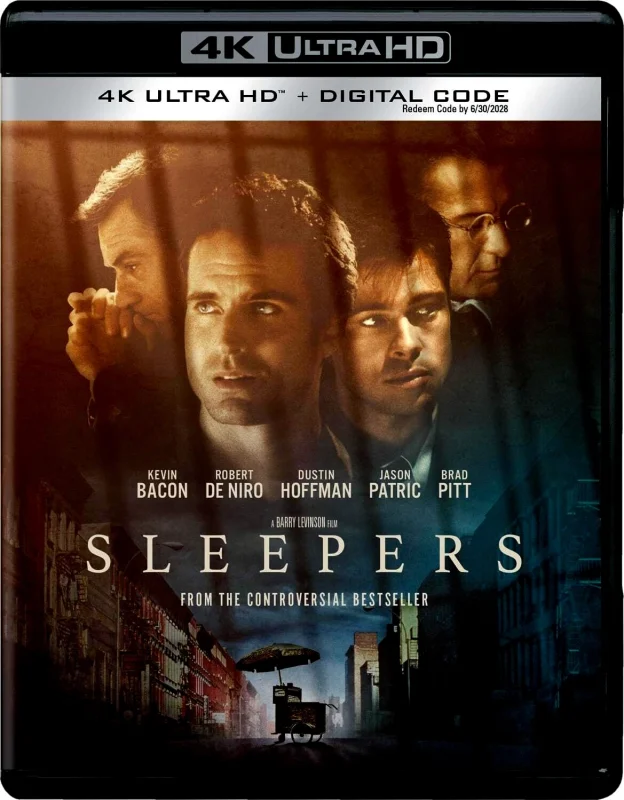
Codec: HEVC / H.265 (67.9 Mb/s)
Resolution: Native 4K (2160p)
HDR: Dolby Vision, HDR10
Original aspect ratio: 2.39:1
#English: DTS-HD Master Audio 5.1
#English: DTS-HD Master Audio 5.1
#French (Canada): Dolby Digital 5.1
#French: DTS 5.1
#Spanish: Dolby Digital 2.0
#Spanish: DTS 5.1
#Italian: DTS 2.0
#German: DTS 5.1
#Russian: DTS 5.1
‘Hell's Kitchen’ truly lives up to its ill-gotten nickname. I’ve come across references to this neighborhood in various films more than once, and some were entirely devoted to this troubled place, a landmark of history in its own right. Among the recent films that are definitely worth watching, two caught my eye: "State of Ecstasy" and "Sleepers".
Both feature an absolutely incredible cast, with one actor better than the next, each character more endearing than the last; taken together, this talented and diverse ensemble is simply a delight to watch—absolutely delightful. But while “State of Ecstasy” can be exhausting with its 134-minute runtime, the entire 147 minutes of “Sleepers” fly by completely unnoticed. In general, one might note that certain moments drag on a bit, but this flaw is easily attributed to the transition from one plotline to another, so this observation is essentially insignificant.
The first half of the film, which covers the childhood of the four protagonists—from the brutal streets of the city to an even more brutal prison—forms the foundation of the entire film. The young actors, each in their element (I’d especially like to single out Brad Renfro) + the dignified De Niro in a juicy role as a priest—pardon me, that slipped out—+ Kevin Bacon in yet another utterly repulsive role with a cheerful yet malicious gleam in his eyes: “See what a bastard I am?
what, does that piss you off?“—all of this leaves no other description than ”excellent.“
Practically the entire second half of ”Sleepers," with the subsequent trial, drags a bit, and the trial itself sometimes feels far-fetched, especially Ralph Ferguson's cross-examination. On top of everything else, the cards of the upcoming case were laid out before us in advance, sending the much-desired intrigue far away, and the cover-up case isn’t nearly as interesting as the fierce battles fought not for life, but for death. However, as someone with a mad passion for various courtroom dramas, I still couldn’t help but note one moment that stuck firmly in my mind—a predictable yet no less impressive move: not forcing, but asking (!) the priest to lie under oath.
I’d like to give a special mention to the role of the alcoholic lawyer, played with great dedication by Hoffman, but I’ll spare you the praise for Pitt right away, because the role is uncertain—that is, Brad’s performance is extremely uncertain. His eyes wander, his emotions are essentially superficial, and what really ruined it for me was the moment of his very first appearance on screen—the conversation with Shakes and the words about revenge.
And I want to note the excellent ending, right after the trial concludes and leading up to the credits. Along with the first half of the film, I’d like to describe this part with the same word: excellent.
 Telegram and be the first to know about updates!