Login / Register
Guest
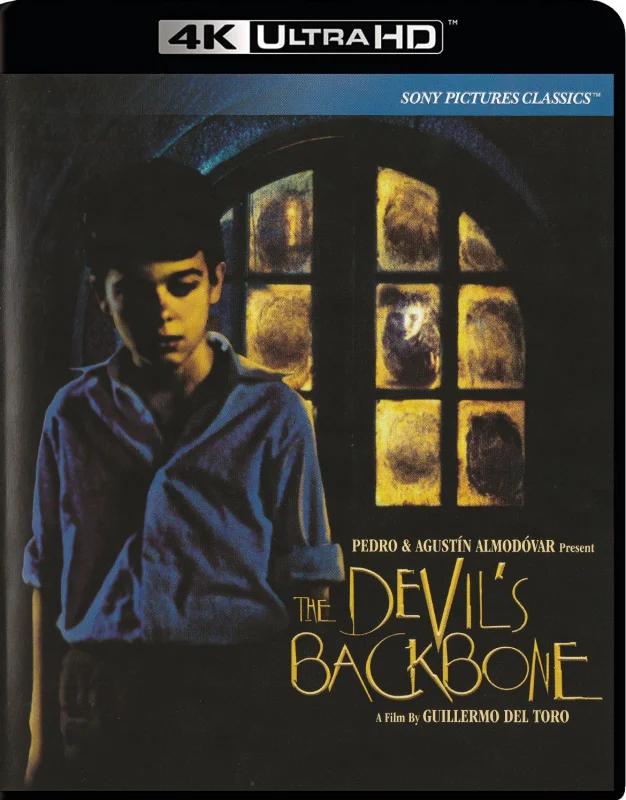
Codec: HEVC / H.265 (83.4 Mb/s)
Resolution: Upscaled 4K (2160p)
HDR: Dolby Vision, HDR10
Aspect ratio: 1.85:1
Original aspect ratio: 1.85:1
#Spanish: DTS-HD Master Audio 5.1
#French: DTS-HD Master Audio 5.1
Filmed long before "Pan’s Labyrinth", "The Devil’s Backbone" didn’t reach Russian theaters until after its successor. There is no doubt: distributors’ interest in Guillermo del Toro’s earlier work is driven by the obvious success of *Pan’s Labyrinth*, as well as the great interest from audiences and critics in his most recent film. Moreover, it is no secret that the director plans to create a trilogy, which, in addition to the aforementioned films, will include the film “3993,” scheduled for release in 2009, which will undoubtedly capture the attention of a wide audience.
The events of "The Devil’s Backbone" take place in Franco’s Spain. The main character here is an orphaned boy, sent by his guardians to a remote orphanage to be raised by an elderly professor and his one-legged friend. In the middle of the orphanage courtyard, an unexploded aerial bomb, its nose buried in the ground, stands like an exclamation mark. Attention!
The mystery of "The Devil’s Backbone" is not a labyrinth, but a ghost sighing in the basement by an abandoned well. What is he seeking in this world, and who sent him to the other side? To make contact, the spirit takes on a real form in the eyes of Carlos, a comic book-loving boy whom the headmistress affectionately calls “Carlito.”
And Carlito’s journey through “The Devil’s Backbone” will be no less dangerous and mysterious than Ofelia’s adventures in the fairy-tale mirror world of “Pan’s Labyrinth.” True, this time the trials facing the protagonist are not the result of the mysterious Faun’s will, but rather the result of ordinary boyish dares, when, faced with the fear of the dark and the danger of being exposed, the boy’s strong character and extraordinary resilience are revealed.
The war is not nearby—it is far away, appearing only briefly in a scene of a partisan execution. It is, evidently, merely a device allowing Del Toro to heighten the atmosphere of his film, constructing an extreme situation that, when it erupts, becomes a moment of truth for all the characters.
Here is his own masterwork, and the naturalism of violence and pain is no less explicit than in *Pan’s Labyrinth*. Del Toro, as is his tradition, sacrifices naturalism and the raw honesty of facts on the altar of authenticity, and if the plot demands it, he will run a knife across a child’s face, riddle children’s backs with shards of glass, not to mention sewing up lacerated flesh, shootings, and child bodies blown apart by explosions, drenched in blood, and charred.
The director dissects motifs and characters, emphasizing nuances of behavior, psychology, and personality traits, tracing the life paths of his heroes, reflecting on trampled values, while preserving in the child the purity of thought and strength of spirit that overcomes the fall and decay represented by the ungrateful monster of the cruel real world. Del Toro’s ghost turns out to be friendlier and kinder than the flesh-and-blood inhabitants of “this world.” In short, the devil isn’t as scary as… living people.
 Telegram and be the first to know about updates!