Login / Register
Guest
Codec: HEVC / H.265 (69.6 Mb/s)
Resolution: Native 4K (2160p)
HDR: HDR10
Aspect ratio: 1.67:1
Original aspect ratio: 1.66:1
#English: DTS-HD Master Audio 5.1 (48kHz, 24-bit)
After watching ‘Taxi Driver’—it seems to me that whatever Scorsese made next was doomed to fail; after such a heart-wrenching masterpiece as ‘Taxi Driver,’ it was simply difficult to go any further. Now, of course, we know that Scorsese went on to make far more interesting and successful films, but the indescribable atmosphere of ‘Taxi Driver’ will live on forever—not only in that film itself, but also in the memories of every viewer who has seen it.
No matter how often the great director returns to his beloved hometown, the image of New York from ‘Taxi Driver’ is always before my eyes; even in ‘Goodfellas,’ Scorsese himself doesn’t attempt to create a new vision of New York from the inside, limiting himself to a single neighborhood. When turning to films set in the past, the director still pays attention to the city, though not to the same extent—whether in “Gangs of New York” or “The Age of Innocence.” And while the former, like “Taxi Driver,” depict the city’s underbelly, the atmosphere of “Taxi Driver” remains unmatched. High society, on the other hand, doesn’t even attempt to do so—neither in “The Age of Innocence” nor, to some extent, in “New York Stories.”
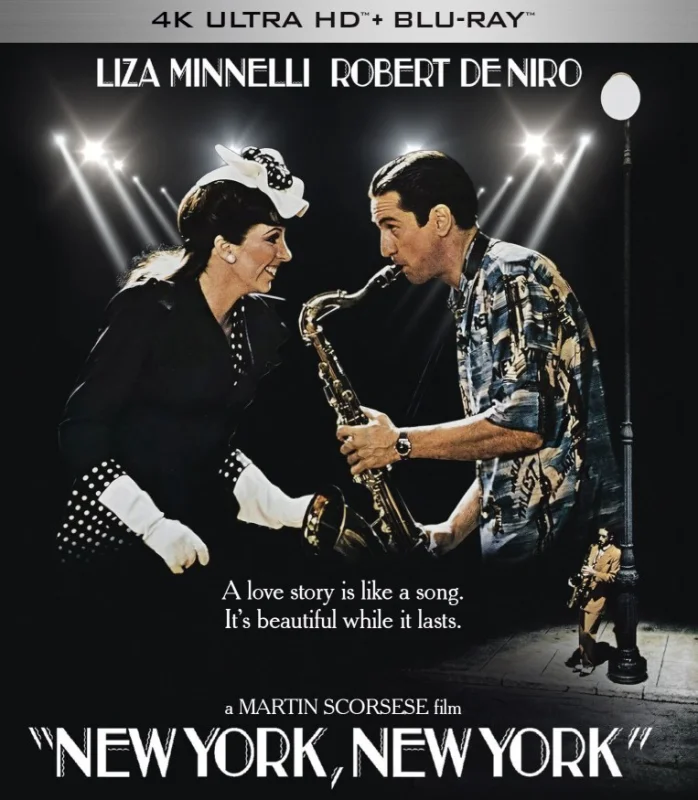
So, having shown the inner workings of New York’s underbelly, was the director left with no choice but to present this city in a new light in a film where the city’s name is part of the title? Fortunately not; most of the film’s scenes take place not even in New York itself, but in other states. But all the characters’ paths lead to a meeting place: the city of New York, whose basements—dating back to the end of World War II and the founding of the UN—resound with the sounds of jazz, at a time when Black people’s rights were still limited, yet they played their music better than anyone else.
But all the talent belongs to the white characters, and naturally, Robert De Niro and Liza Minnelli’s characters take center stage. It’s not exactly a romantic encounter—more of a comical “second meeting”—and the very next morning, they flee the hotel… But this brings the characters together, and not just in a creative sense. But what about the law of show business: one is always better than the rest.
And how can a man come to terms with the fact that a woman is outshining him—and not just any woman, but his own? Jealousy of success is sometimes stronger than jealousy of lovers, and that’s exactly what happens here. But even before that, the film has a couple of amusing moments—especially the “wedding” scene—and some scenes are so captivating simply because of their setting that they make you feel as though you’re watching the film not at home on TV, but in a theater—and why not on Broadway?
Musicals, of course, aren’t my thing, but I did enjoy the jazz—even though I don’t know much about it. Back in the day, I’d often head out to one of the city’s nightclubs where local bands played live jazz; you could just sit back, chat about nothing in particular, and the music didn’t distract you—it was more soothing than anything. Watching this film evokes somewhat similar feelings, as the movie seems to drag on for what feels like an eternity—it’s no wonder the filmmakers depict nearly the entire lives of the characters in their story.
Aside from the music and the acting, Martin Scorsese’s production design may differ from other musicals, but it actually resembles them. It features the same cardboard sets, yet in “New York, New York,” he truly created a backdrop that’s unforgettable to the eye. Sometimes it seems as though these aren’t sets at all, but nature itself and real snow—perhaps that’s the case, but it isn’t all that important. What matters is something else: Scorsese’s genius, and the fact that he is the best director, having excelled in various genres, from black comedy and musicals to biopics and crime dramas.
 Telegram and be the first to know about updates!