Login / Register
Guest
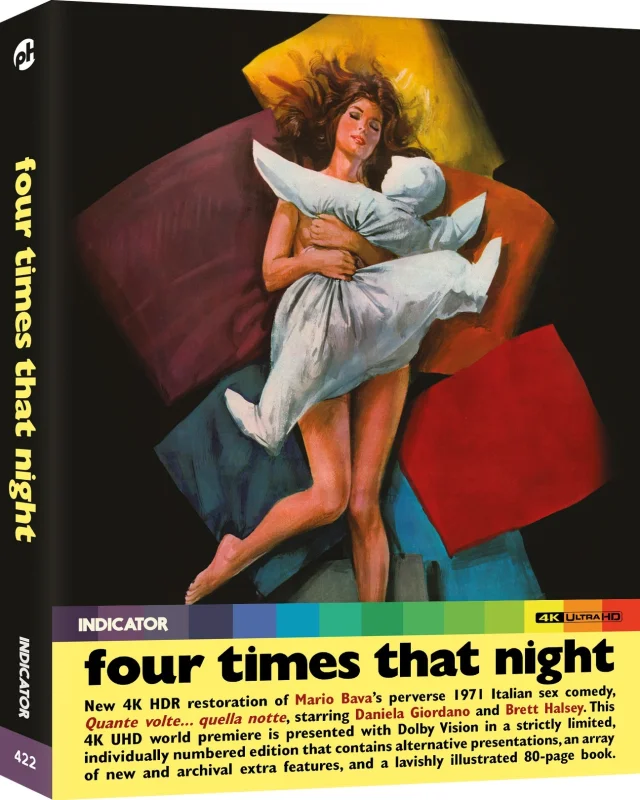
Codec: HEVC / H.265 (80.3 Mb/s)
Resolution: Native 4K (2160p)
HDR: Dolby Vision, HDR10
Aspect ratio: 1.85:1
Original aspect ratio: 1.85:1
#English: FLAC 1.0
#Italian: FLAC 1.0
When preparing to watch a movie and seeing Mario Bava’s name in the credits, the viewer automatically expects a “horror” film. But here we have a light, sexy comedy with pretensions to philosophical depth.
Perhaps this is precisely why the film *Four Times That Night* went virtually unnoticed. Bava probably just enjoyed making the film. After all, the plot is very realistic:
A young man goes out for an evening walk with a girl, and she returns in the morning. Her dress is torn, and he has a scratch on his forehead. Next, the director lets us hear the woman’s version of what happened.
We realize that someone tried to rape the heroine. Brutally and abruptly.
Now, let’s hear the man’s side. Of course, according to his version, there was sex and the woman’s promiscuous behavior, marred by her sudden irrationality.
However, there is a third version—that of a man who was spying on the characters. The doorman, by the way. But if you listen to him, the whole thing boils down to the male lead’s alleged bisexuality.
So what’s the deal? Why do three people offer completely different interpretations of what happened? At the very end, the director offers his own interpretation. It will differ fundamentally from the first three, but it won’t rule out the possibility of other interpretations.
Daniela Giordano handled her role quite naturally—a vibrant, young, sexy girl. She could very well have become a star, by the way. It’s unlikely that Barbara Bach or Ornella Muti would have played the part any better than she did.
Her co-star, Brett Halsey, was also good. Many years later, he would give simply magnificent performances in several “maniacal” roles in Lucio Fulci’s films.
 Telegram and be the first to know about updates!
 [/xfnotgiven_poster]