Login / Register
Guest
Codec: HEVC / H.265 (83.4 Mb/s)
Resolution: Native 4K (2160p)
Original aspect ratio: 1.85:1
#Italian: FLAC 1.0
#English: FLAC 2.0
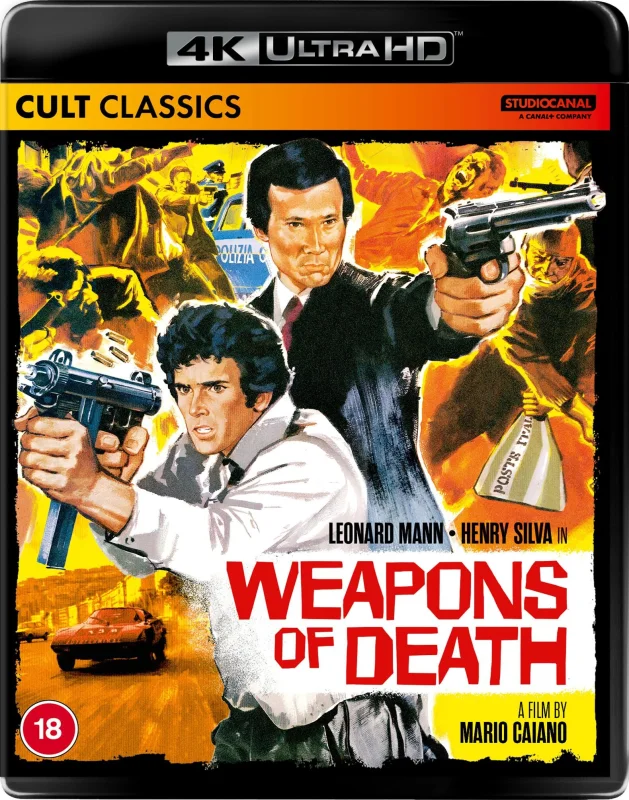
Yet another “Eurocrime” film from Mario Caiano. The cast included several familiar faces from other films in the same genre, but the most famous member of the entire cast was, of course, Henry Silva. To this day, I still don’t understand what it was about his acting or his personal qualities that made him a regular in every other Italian action movie of the 1970s. He certainly has a colorful appearance, but I wouldn’t say it’s anything that really sets him apart from the crowd of other cinematic “bad guys.” Nevertheless, this film relies mainly on him—or rather, on the very fact of his unseen presence in the criminal underworld of Naples.
So, in the sunny city of Naples—which is already no stranger to criminal incidents—a series of daring and bloody robberies takes place. And while the first robbery—an attack on a bank—results in a minimal number of casualties, the second and third attacks—on a train and a factory cashier’s office, respectively—cause the number of victims to increase exponentially. The police aren’t exactly powerless, but they’re limited in their means and capabilities to track down and punish the criminals. Although everyone knows from the very beginning who the culprit is. And it seems as though the film will follow a linear narrative—crime, then investigation—but it doesn’t. Already halfway through the film, there’s a bloody climax featuring a shootout (which, by the way, is staged very well and realistically) and a chase. But then, the case takes an unexpected turn.
It seems the secrets have been uncovered, the number of criminals has been reduced—the only thing missing is a legally sound case. And this is where the film pulls off an intriguing twist. The police investigator—Commissioner Belli, played by Leonard Mann—suddenly finds himself on the slippery path of crime. And he begins to do things that bring to mind the dialogue between Watson and Holmes, where Watson suggested that Holmes could have been a brilliant criminal had he not become a detective. It’s all so easy and effortless for Belli and his team to copy the style and methods of those they’re fighting against. Lacking evidence obtained through legal means, he and his associates acquire everything they need through methods that fall far short of even Italy’s liberal laws—and they do so effectively.
As the plot unfolds, the viewer is treated to several thrilling chases and a final showdown, punctuated by heavy casualties on both sides of the conflict.
From an aesthetic standpoint, the film is somewhat disappointing due to its lack of high-quality visuals. The film deserves a decent Blu-ray release. However, the director’s and cinematographer’s work, combined with the editing, is technically sound.
The screenplay is good. It’s clear that Gianfranco Clerici and Vincenzo Mannino were familiar with the realities of Italy’s gang wars and were quite knowledgeable about the inner workings of the Neapolitan criminal underworld.
The music in the film is decent, but not particularly memorable. Mr.
Francesco De Masi didn’t quite measure up to the works of Ennio Morricone and Bruno Nicolai, but at the same time, he didn’t embarrass himself either.
 Telegram and be the first to know about updates!