Login / Register
Guest
Codec: HEVC / H.265 (71.0 Mb/s)
Resolution: Native 4K (2160p)
Aspect ratio: 1.37:1
Original aspect ratio: 1.37:1
#French: DTS-HD Master Audio 5.1 (48kHz, 24-bit)
#English: Dolby Digital 1.0
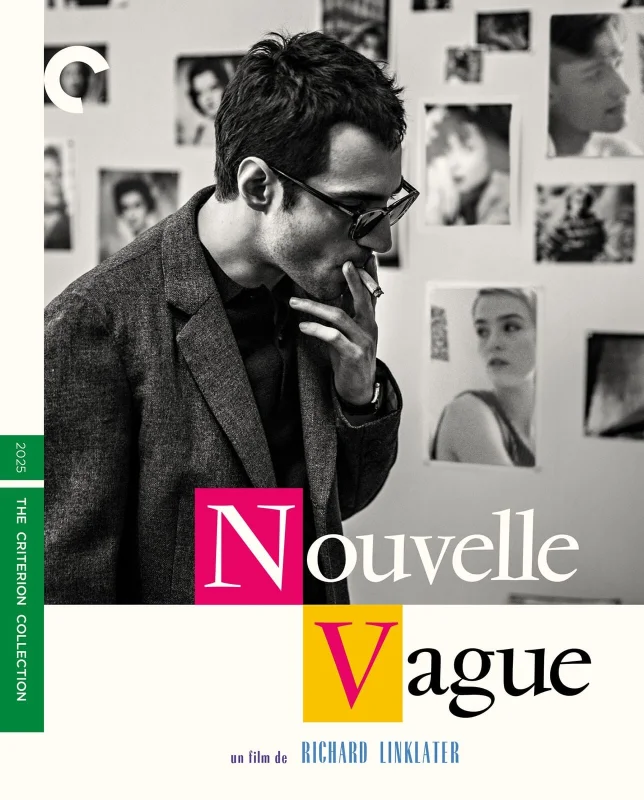
The first thing you’ll want to do after watching Richard Linklater’s “Nouvelle Vague” is to immediately rewatch "À bout de souffle". I hope distributors and theaters will come up with the idea of showing Linklater’s and Godard’s films back-to-back. A cinephile “double feature” like the ones Quentin Tarantino enjoyed as a child—who, by the way, saw “Nouvelle Vague” at its premiere in Cannes and reacted very enthusiastically during the closing credits.
At the same time, “Nouvelle Vague” should, paradoxically, also resonate with an audience that knows nothing about filmmaking in general or about the passionate critics of "Cahiers du Cinéma" who went on to become famous directors.
The protagonist’s dilemma is clear and relatable. All his colleagues and friends have already found success in their new fields, but he can’t seem to get anywhere, even though time is running out (30 years old—a mere trifle by today’s standards, but not in the 1960s). And so the protagonist decides to take action, but faces resistance from all sides. Nevertheless, he sticks to his guns, does things differently from everyone else, and even if he fears failure, he doesn’t let it show, hiding behind quotes from the greats. All of this is portrayed with nonstop humor or irony—not in a dramatic vein, but in a comedic one.
The pace mirrors not that of a film set (where, as we know, everything moves rather slowly for an outsider), but rather that of rehearsals with the actors or the final stage of preparation.
Some critics have accused Linklater of making “Nouvelle Vague” too contrived, not quite as free as, in fact, the early films of Godard, Truffaut, and company were.
But Linklater remains consistent in this choice as well—he makes films for audiences, so he strictly adheres to both the chosen form and the dramatic structure. If there are 20 days of shooting, then there will be something to say about each one. Bresson, Melville, and, of course, Rossellini will all appear on screen. It seems like a cinephile’s delight, but each will be portrayed in such a way that their character becomes clear even without knowing the context.
And yet Godard remains the film’s main character—no matter how many other stars surround him in the film. Through the making of his debut feature film, we learn a bit about him as a person. We connect with him, so in the finale, when the filming of "Breathless" wraps up, a sense of sadness inevitably creeps in—the characters have become like family to us. And isn’t that one of the hallmarks of great cinema?
 Telegram and be the first to know about updates!