Login / Register
Guest
Codec: HEVC / H.265 (55.7 Mb/s)
Resolution: Native 4K (2160p)
Aspect ratio: 2.39:1
Original aspect ratio: 2.39:1
#English: Dolby TrueHD 5.1
#English: Dolby Digital 5.1
#German: DTS-HD Master Audio 5.1
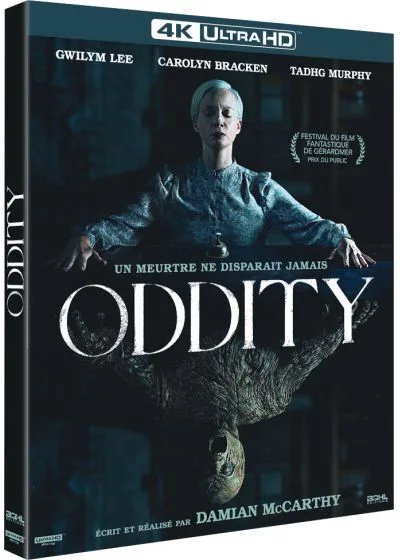
Irish director Damien McCarthy opens the film with scenes of the brutal murder of a psychiatrist’s wife, whom a man who had escaped from a psychiatric hospital had tried to warn of the impending danger. A year later, her blind twin sister arrives at the psychiatrist’s house—where the murder took place—to use her psychic abilities to find out who actually killed her sister.
“Oddity” has absolutely nothing to do with James Wan’s “Insidious” and its numerous spin-offs; it is merely a ploy to pique the interest of an unsuspecting viewer. Everything in the film is strange—from the patients at the psychiatric clinic to the twin sisters, who seem to bear no resemblance to one another at all. The oppressive atmosphere of the Irish countryside, with an empty stone house, a wooden man comfortably seated at the dining table, and a peculiar sense of humor—everything in this film is truly strange, which makes it very hard to look away.
Dani (Carolyn Bracken) is left alone in an old country house, far from civilization. Late at night, there’s a loud knock at the door. She looks through the peephole and sees a man (Taig Murphy) with a glass eye and a face contorted with fear. He tells her he saw someone enter the house and that she’s in danger. Dani, naturally, doesn’t believe him and hesitates to open the door. It might be a trap. Although she did hear some noises upstairs. What if he’s right? Then the film suddenly jumps forward a year, leaving the viewer in suspense. Dani was killed that night, and the event is shrouded in mystery. Her widower, Ted (Gwilym Lee), goes to the “curiosity shop” run by Dani’s blind twin sister, Darcy (also played by Bracken), and brings her a glass eye that belonged to the man who came to warn Dani that night and may have killed her. Darcy touches the eye, and everything suddenly falls into place, setting off a chain of events that are hard to predict. After offering the viewer a promising start, the plot continues to unfold at the same pace, without slowing down one bit.
McCarthy is very patient as a director. He knows how to wait. He doesn’t try to scare the audience right away. He lets the sense of unease build and build. The carefully calibrated pace of the narrative leaves the viewer no chance to catch their breath or predict where the story will go next. Largely thanks to the skill of the cast, whose grounded yet intense performances ensure the film confidently reaches its conclusion without slipping into predictable genre clichés. The final shot will exceed all expectations, making the viewer jump in surprise one last time and immediately break into a smile—even despite the rather eerie image with which the director masterfully concludes the narrative, saving the best for last.
Perhaps, through this film, the director wanted to suggest that sometimes it’s actually worth trusting the crazy strangers who persistently try to break into your house in the middle of the night, warning you of danger. That is, of course, only if you’re alone at night in an empty house in the Irish woods with no means of communication; otherwise, it’s probably not a good idea after all.
 Telegram and be the first to know about updates!
 [/xfnotgiven_poster]