Login / Register
Guest
Codec: HEVC / H.265 (60.0 Mb/s)
Resolution: Upscaled 4K (2160p)
HDR: HDR10
Aspect ratio: 2.39:1
Original aspect ratio: 2.39:1
Anime is allowed to do a lot—if not everything—in terms of visual and narrative storytelling. Anime has had, has, and will continue to have major franchises: just look at the utterly psychedelic Batman (actually, two of them)—and then there’s Star Wars, Transformers, and so on. There have also been major writers in anime: from Nietzsche’s pretentious pronouncements to, quite literally, a Dostoevsky-esque hero. And now we’ve reached Hamlet.
Moreover, "Scarlet" retells it in a language that doesn’t so much translate Shakespeare into a visual plane as it reassembles the very architecture of the Shakespearean myth. Eggers did roughly the same thing in ‘The Viking’ (2022), drawing on the core of the Hamlet story—but in the anime, we see not just a different perspective and different emphases, but something ENTIRELY DIFFERENT.
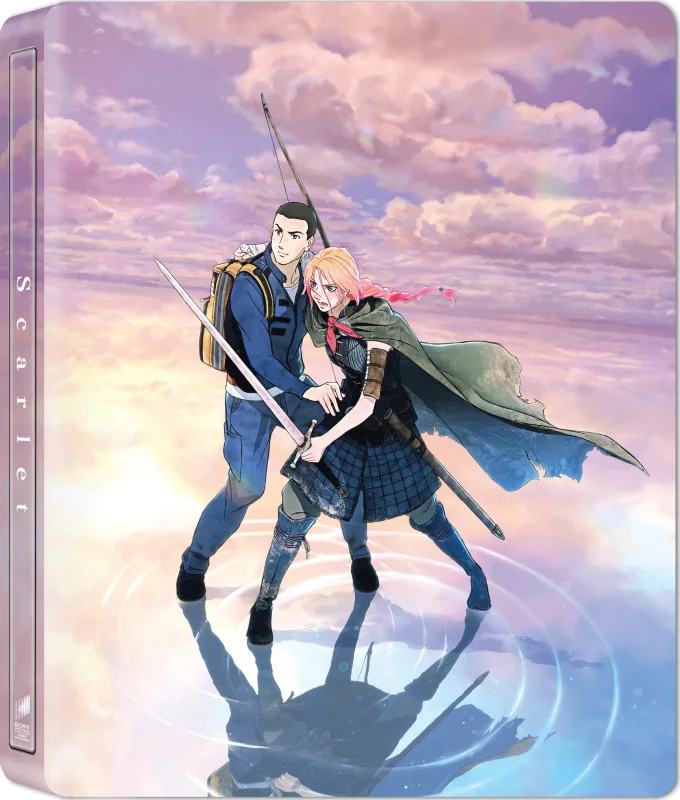
And it seems like, yes, we’re looking at a typical Netflix approach: swap the male hero for a female one, give her colored hair (here it’s pink), and throw in some talk about emancipation and capitalism (+criticism of patriarchy). BUT NO! Yes, instead of Hamlet we have Scarlett with pink hair, but her story is completely different; her hatred outlives even her death and serves as the plot’s guiding thread. Where Hamlet thinks and doubts, Scarlett acts. And in general, all that remains of Shakespeare’s original plot is a faint outline, upon which Hosoda weaves a completely different picture: a story not so much about revenge or even power—but about the importance of a specific life, shared experiences, and thoughts. The idea is banal, but life in the present is far more valuable than revenge for the past.
Another thread is also interesting: the film features a level of multiculturalism that is enviable (one can recognize certain traditions from different cultures and eras)—the only problem is that such equality is possible only after death. It is precisely in this context that the film introduces its main metaphor, which is highlighted in the title of this review: true multiculturalism and cosmopolitanism become possible only after death: the death of the father, the death of the old world, the death of Scarlett herself in her former role as an avenger. Hosoda consistently shows that as long as the heroine tries to act within the framework of the institutions offered to her (family, public opinion, revolution), she inevitably reproduces the logic of violence that led to her father’s death, and every step she takes only reinforces the very system she hopes to destroy.
This also lays bare the fact that the classic conflict of "Hamlet"—the struggle for the legitimacy of power—cannot, from a contemporary perspective, be resolved within the framework of a nation-state narrative, but requires a shift into a space where the very concept of “homeland” loses its sacredness and becomes just one of many constructed myths.
It was hardly intended this way, but that is exactly how it turned out
In this sense, "Scarlet" continues Hosoda’s lineage of heroes and heroines: from "The Girl Who Leapt Through Time" and "Summer Wars" to "Beauty and the Beast"—his characters find themselves within a hierarchical society and a situation that calls it into question and threatens to destroy that very society. And the characters grow because they stop viewing society as a limitation and embrace the idea that everything around them not only weighs them down but can also help. There are no stories outside of a living dialogue between people—we must not replace it with traditions, ancestors, or anything else that isn’t in the same room with us. That is how we save ourselves.
 Telegram and be the first to know about updates!