Login / Register
Guest
Codec: HEVC / H.265 (87.1 Mb/s)
Resolution: Upscaled 4K (2160p)
HDR: Dolby Vision, HDR10
Aspect ratio: 2.39:1
Original aspect ratio: 2.39:1
#English: Dolby TrueHD with Dolby Atmos 7.1
#English: Dolby Digital Plus with Dolby Atmos 5.1
#Spanish (Latino): Dolby Digital Plus 7.1
#French: Dolby Digital Plus 7.1
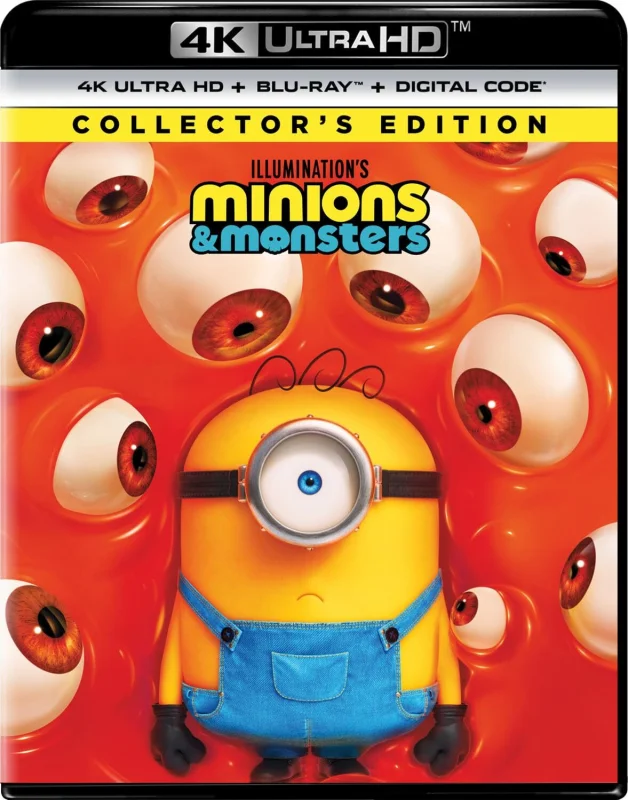
One of the strengths of the computer-animated film “Minions & Monsters” is the depiction of a monstrous abomination in the form of a huge, multi-eyed orange slime, with eyes that are small but numerous—like the eyes on a potato. It was very unexpected; for the screenwriters, this was a clever, non-clichéd idea. There’s also a likable and unexpectedly small green monster with three noses—which look like either tentacles or dangling snot—whose noble impulse of gratitude was stifled by his interaction with two, alas, clichéd monsters from the freezer.
The cartoon features several eccentric moments when a character abruptly changes course—a monster that looked terrifying in the illustration in the spellbook turns out to be disappointingly small, and a romantic robot, after unexpectedly appearing to show cowardice, actually rushes off to summon a fleet of flying saucers for backup. At these moments, genuine laughter rang out from the audience.
However, the minions’ characters in this series are less well-developed; their names aren’t memorable, unlike Dave and Stuart from the film released thirteen years ago.
The historical backstory takes up a lot of time; the main plotline doesn’t really begin until about 35–40 percent of the way through the film.
The animated film is filled with allusions and references to Hollywood films from the 1920s and 1930s, and there are anachronisms—the main action takes place in 1927–1928, but there’s a reference to Charlie Chaplin’s film “Modern Times,” which was released in 1936.
A slimy, multi-eyed monster is shot by American tanks resembling the M4 “Sherman” (General Sherman), which were produced starting in 1942.
The film can be used as a quiz for connoisseurs of American cinema from the interwar period (between the two world wars). The frail film director Max is, as one might assume, a reference to Max Linder; however, in the cartoon he speaks with distinct German words interspersed in his speech, whereas the American film director Max Linder was of French origin; moreover, he committed suicide in 1925, even before the time period depicted in “Minions & Monsters.”
The cartoon addresses the issue of the transition from silent to sound film—a topic already satirized in Ilf and Petrov’s “The Golden Calf”—which should bring a smile to the faces of connoisseurs and admirers of Soviet satire.
The film is rich, multifaceted, and interesting in many ways. One of its weaknesses is the underdeveloped romantic subplot—although the feminist and women’s rights advocate bears some resemblance to Jillian Gru’s neighbor from “Despicable Me 2,” the rapid succession of her scenes prevents us from fully appreciating her in all her glory; the personality of her robot boyfriend—whose voice resonates from his torso, sounding as if it’s coming from a barrel—distracts attention from the girl.
Despite these shortcomings, the computer-animated film “Minions & Monsters” will be of particular interest to fans of film photography and cinema; the filming equipment depicted in it is historically accurate and believable, with the exception of the extremely narrow-gauge film camera carried by one of the Minions, which is clearly not designed for the 35 mm format, nor even 16 mm, but rather 8 mm—8-mm film was not invented until 1932 by Eastman Kodak. The Minions refer to film and movies as “película”—that is, “film” and “movie” in Spanish, the language that dominates their vocabulary.
 Telegram and be the first to know about updates!