Login / Register
Guest
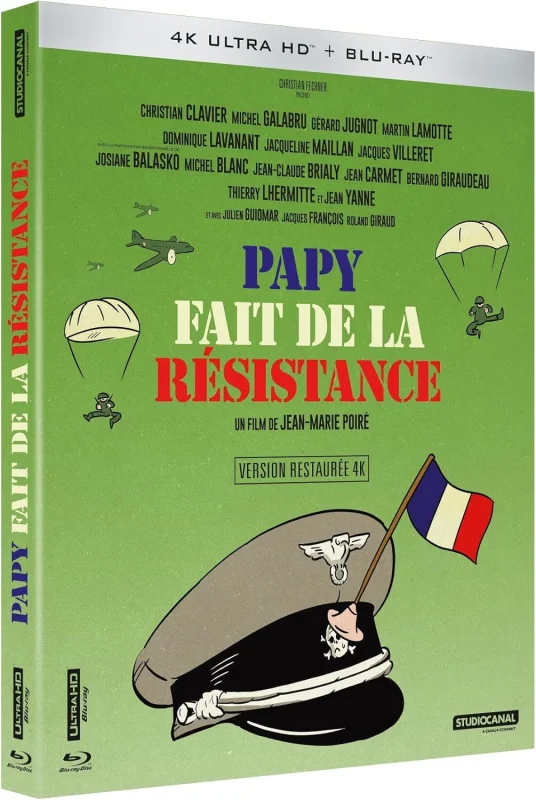
Codec: HEVC / H.265 (60.9 Mb/s)
Resolution: 4K (2160p)
HDR: Dolby Vision, HDR10
Aspect ratio: 2.35:1
Original aspect ratio: 2.35:1
#French: FLAC 2.0
The Bourdelle family were hereditary musicians, applauded by the whole world, who lived peacefully on their estate before the war. But then, on the orders of the German high command, the mansion was temporarily handed over to the local occupation authorities as a commandant's office, and the Bourdels had to move into the basement to make room for General Sponze and his subordinates.
So, the following people are forced to huddle together in the cramped basement: Hélène Bourdelle, the widow of a Resistance activist and a famous opera singer; her children Guy-Hubert (a mannered and cowardly hairdresser), Bernadette (a beautiful cellist who captivated General Sponcz), and Colette (a simple flirt); grumpy old man André; Bernadette's fiancé and lodger Michel. But that's not all—they are joined by a wounded prisoner who escaped from the commandant's office. Upstairs, General Sponcz and his favorite Russian prisoner of war, a cat named Gustav, roam about, periodically joined by either a sycophantic Gestapo officer or Hitler's stepbrother, who wrote Mein Kampf. And if you think that's the end of it, add to that a hero nicknamed Superpartisan in a cloak, top hat, and mask—the spitting image of Tuxedo from Sailor Moon—and you'll get an idea of Jean-Marie Poiré's brainchild. At times, it feels like you're watching some kind of phantasmagorical vaudeville.
With such a dense cast of characters, the film simply has no time to sag, and although it can't be called sparklingly funny, it's easy and relaxing to watch. Although there are a couple of frivolous scenes, on the whole, the humor does not descend below the belt, remaining at the level of situational jokes, at times reminiscent of the Marx Brothers' less successful works. I was pleased that the love story was not brought to the forefront, overshadowing everything else. I would have removed the final part with the aging characters, but that's a subjective opinion.
The French often return to the theme of the Resistance, although in reality not that many of them actually participated in its activities (for example, in 1943, there were about 100,000 participants in the movement — less than one percent of the total population). When it comes to the wealthy and cultural figures, there were quite a few supporters of the Vichy regime among them. In this sense, the huge number of books and films dedicated to la Resistance may, in a sense, be an attempt to pass off the desired as the actual.
And yet, regardless of historical realities (and this is probably how one should view the comedy, especially one dedicated to the memory of Funes), Poiret's film is full of a kind of musketeer spirit, and hurrah-patriotism, which give rise to the liveliness that makes Papy worth at least a cursory viewing. Of course, Poiret is no longer Gérard Oury, but he is quite comparable to Claude Zidi (especially in his later works).
The only question is why the title of the film refers specifically to Papy, when the roles of other family members in the Resistance were incomparably greater...
 Telegram and be the first to know about updates!
 [/xfnotgiven_poster]