Login / Register
Guest
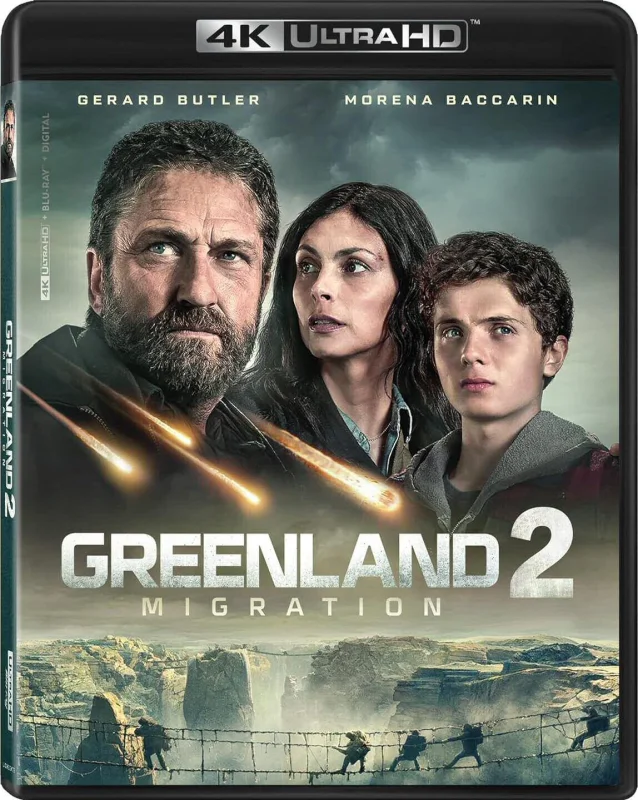
Codec: HEVC / H.265 (78.3 Mb/s)
Resolution: Native 4K (2160p)
HDR: HDR10+
Aspect ratio: 2.39:1
Original aspect ratio: 2.39:1
#English: Dolby TrueHD with Dolby Atmos 7.1
#English: Dolby Digital Plus with Dolby Atmos 5.1
#Spanish (Latino): Dolby Digital 5.1
By the time the sequel was released, the title “Greenland” had inadvertently taken on a new meaning. This is because the president of a certain major country is eager to get his hands on this Danish island. And in the context of the film, one might say with a smile: “Well, it’s obvious why he wants it. There’s a perfectly equipped bunker there where you can survive the end of the world!” Which, of course, is pure fantasy. Although perhaps the American leader knows something.
Well, if we set aside the pressing political agenda, “Greenland 2: Migration” is a treat for those who enjoyed the first installment. In fact, the sequel was made for fans, as it is essentially a direct continuation of the original. Even though the filmmakers spent a minute at the beginning reminding us of the comet that wiped out the vast majority of people on Earth, overall it feels like the second episode of a cinematic miniseries. John (Gerard Butler), Alison (Morena Baccarin), and their son Nathan (Roman Griffin Davis) survived the apocalypse in an underground shelter in Greenland, along with a few dozen other lucky survivors. But after five years in the shelter, food supplies are nearly gone, and it hasn’t gotten any safer on the surface. What’s more, another earthquake strikes the island—far stronger than the previous ones—and the main characters hurriedly flee the crumbling bunker. Now their path lies across the sea by boat to the south of France, where, according to unverified reports, there is a huge crater that has somehow miraculously turned into a veritable oasis with forests and lakes, in the middle of a dead zone.
Rick Roman Vo, who directed the previous film, maintains the same stylistic approach in “Greenland 2,” blending science fiction and disaster with elements of melodrama and action. And in terms of plot, this is once again a road movie, where the heroes, throughout the entire runtime, struggle through hardships and deprivations to reach a point of possible salvation. Compared to the original, the sequel’s budget has grown by as much as 2.5 times, but this is likely due to inflation rather than a dramatically increased scale of production. In the first part, comet fragments rained down on Earth, at times in a veritable carpet bombing, with accompanying effects of explosions and massive destruction. In the second installment—earthquakes, massive waves, and more intense combat, driven by the struggle for habitable land. But overall, it feels as though *Migration* was made for roughly the same budget.
The sequel retains an important strength of the original—a solid script. Yes, it’s a typical Hollywood film for a mass audience, but one in which the characters’ motivations are clearly defined and there are plenty of genuinely surprising moments. Some might complain that too much emphasis is placed on the “tearjerker” aspect, but in this particular story—which is, in fact, about family values—the tragic tone is entirely appropriate. It’s worth noting again that if you were more or less satisfied with the first *Greenland*, which had its share of emotionally charged family issues, the sequel strikes the same note—except that the marital rift is replaced by a different kind of crisis.
Moreover, despite the ostentatious excess of emotion, the story itself is quite harsh, and reaching the finale is by no means guaranteed for everyone. While human cruelty isn’t elevated to an absolute here, as it is, for example, in the zombie apocalypse of *28 Days/Weeks/Years Later*, there is more than enough thematic “brutality” in *Greenland 2*. The film was originally aimed at a PG-13 rating, where by definition “scenes of violence and horror are minor,” but the theme of death runs like a red thread through the entire runtime.
Whether there will be a third “Greenland” is hard to say. On the one hand, the story could technically continue. On the other hand, conceptually, the journey to paradise has come to an end. Especially since the Danish island itself, as the main focus of the plot, has been fully exhausted. Unless, of course, they pull a fast one and tell a story about a powerful leader suddenly conquering a “huge chunk of ice.” But, no matter how you look at it, that’s a completely different story, about the prelude to another global crisis.
 Telegram and be the first to know about updates!