Login / Register
Guest
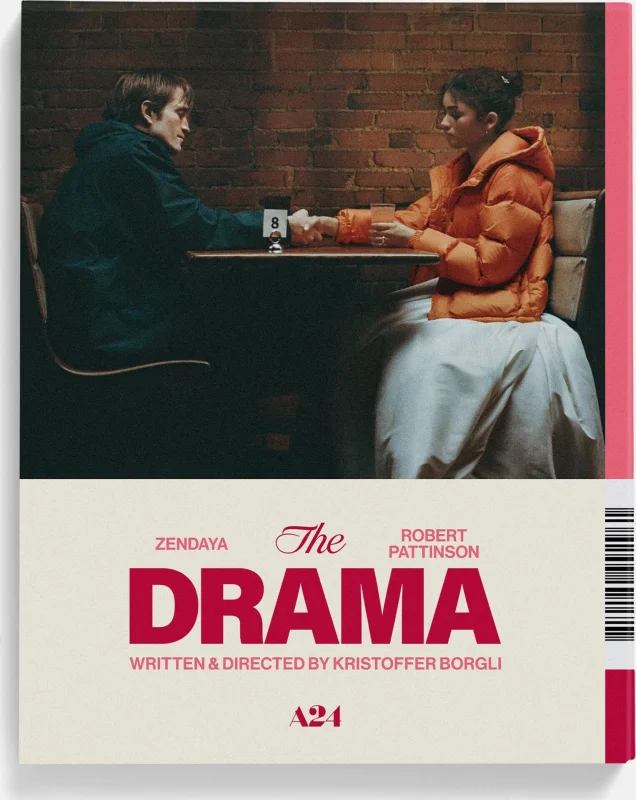
Codec: HEVC / H.265 (86.7 Mb/s)
Resolution: Native 4K (2160p)
HDR: Dolby Vision, HDR10+
Aspect ratio: 1.85:1
Original aspect ratio: 1.66:1
#English: Dolby TrueHD with Dolby Atmos 7.1
#English: Dolby Digital Plus with Dolby Atmos 5.1
#French: Dolby Digital 5.1
I was introduced to Norwegian director Kristoffer Borgli last year after watching his biting satire *Sick of Myself*, and today I’ve already had the chance to see his paranoid film *The Hero of Our Dreams*… And I have to say, he’s quickly become one of my favorite directors. But right now I want to talk about his brand-new film starring Robert Pattinson and Zendaya, which I saw at a press screening yesterday—"The Drama". It’s a psychological comedy of manners that cleverly pretends to be both a rom-com and a thriller, but in reality turns out to be a sharply social commentary on a very uncomfortable topic. There won’t be any spoilers in this post, so as not to spoil the viewing experience. The film explores whether it’s possible to love someone once you learn that they once nearly crossed the line—and where that line actually lies. In all his works, the director explores the cracks in self-esteem and public image, but here he adds a new dimension—the fear of intimacy, when you’ve already let someone into your life, only to realize later that you never really knew them.
Charlie (Pattinson) and Emma (Zendaya) are preparing for their wedding. Everything is idyllic: a chic loft, vintage armchairs, and joint restaurant outings. But during a menu tasting, their friends start a game—telling the story of the scariest thing they’ve ever done. And Emma spills the truth. It’s something that makes Charlie look at her as if she were a complete stranger. Pattinson is magnificent here as an anxious, neurotic nerd who tries to save face but is inwardly consumed by doubts and anxieties. Zendaya’s performance is by her usual standards, but she made me swing between sympathy and revulsion. I think this very ambiguity is the film’s greatest strength: you don’t know whose side to take, and that’s infuriating, yet at the same time, it’s compelling.
Borgi masterfully builds tension by blending reality with unsettling flashbacks that could be either Emma’s memories or a figment of Charlie’s imagination. This makes the film not just a story about a relationship crisis, but a true exploration of paranoia. The irony is that Charlie himself, initially portrayed as the “good guy,” commits acts as the plot unfolds that are no better than what his fiancée didn’t do. The film cleverly flips the question: who actually committed the most terrible act? The one who once planned evil but didn’t carry it out, or the one who commits petty evil right here and now, hiding behind morality?
While I was watching the movie, I kept catching myself thinking: what would I have done? And the longer I thought about it, the less I liked my own answer. Because, probably, I’d panic too. I’d start going over every conversation in my head, looking for hidden hints, noticing “oddities” I hadn’t noticed before. And at the same time, I understand perfectly well that each of us has our dark spots—things we don’t want to be judged for. No one is sinless, and everyone has made a mistake. But where is the line of what’s acceptable? After all, everyone has their own standard for judging what’s “bad.” And don’t our own actions make us just as vulnerable to others’ judgment? Does anyone even have the right to judge another person?
From film to film, Borgli juggles human weaknesses and insecurities, continually putting the viewer in a slightly awkward position. I like his approach—clear and, in part, straightforward, which doesn’t make the films one-dimensional. “The Drama” lives up to its name; it stumbles a bit in its phrasing and may frustrate viewers with its subtleties, but it certainly won’t leave you indifferent. After watching it, you’ll probably want to play the same game with your friends, but first you’ll torment yourself with questions: Would you forgive? Does intention matter if it hasn’t been put into action? And most importantly—are you yourself ready for someone to dig just as deep into your past? There’s plenty to think about. And that’s probably exactly what a good, provocative film needs.
 Telegram and be the first to know about updates!
 [/xfnotgiven_poster]