Login / Register
Guest
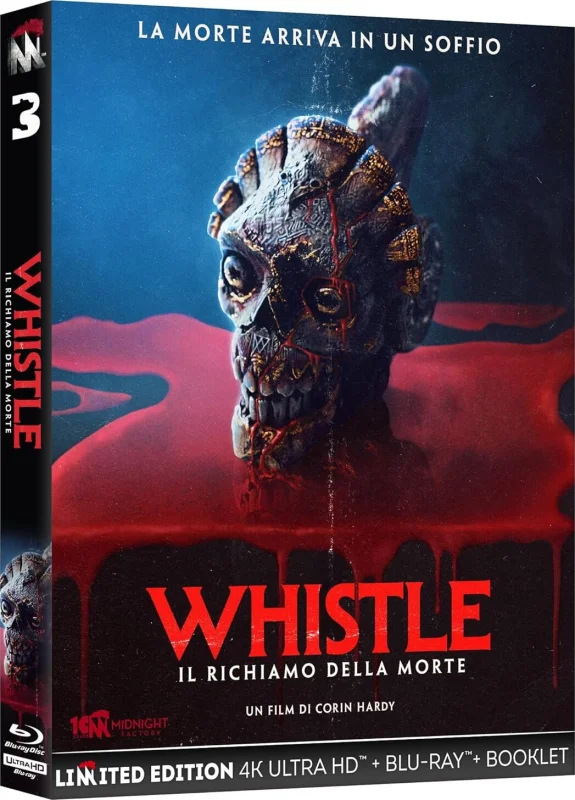
Codec: HEVC / H.265 (80.5 Mb/s)
Resolution: Native 4K (2160p)
HDR: Dolby Vision, HDR10
Aspect ratio: 2.40:1
Original aspect ratio: 2.39:1
#English: DTS-HD Master Audio 5.1
#Italian: DTS-HD Master Audio 5.1
Something’s not right at a typical American high school—a teenager was burned alive right in the athletic locker room! Among his belongings, a group of friends finds a strange artifact—an Aztec whistle—but a greedy teacher decides to resell it online. None of them suspects that anyone who hears that whistle is doomed...
They say—don’t whistle, or you won’t make any money. I don’t know how "Whistle" did at the box office, but I liked the movie—I even whistled a couple of times!
There’s no end to movies following the same formula: “a group of high schoolers finds a doll/diary/tape/book/mask/ancient artifact, after which an ancient curse/monster/ghost/witch/demon is awakened.” Then the ranks of the students thin out, because no one believes in the artifact / they can’t get rid of it / the curse can’t be broken unless passed on to someone else. In the end, there has to be one girl left—what other options are there?
“Whistle” fits this cliché perfectly—and yet it stands out not only for its standout supporting cast (the shady teacher is played by Nick Frost—former hero of the “Cornetto” trilogy and future Hagrid in the new Harry Potter films), but also for its concept: the characters are pursued by inevitable death, but not just any death—a very specific one: the very one that will kill a person in the future. The only catch is that it strikes right now.
A similar premise was used in the *Final Destination* franchise—there, too, the antagonist wasn’t a specific maniac or monster, but Death itself, which tried by any means necessary to claim those who dared to cheat it. But here, the idea is that an ancient whistle—used by the ancient Incas to signal sacrificial rituals—draws a person’s own death toward them.
This concept allows for the depiction of some pretty creepy ghosts that hunt down their younger counterparts—if a girl is destined to die of old age, she’ll be chased by her own older self. And if someone carelessly gets caught in a machine at the factory… well, you get the idea… Death is shown here in close-up, without any euphemisms or camera cuts—I can’t recall seeing such uncompromising realism in modern horror in a long time (the car crash scene without a car and the machine scene without a machine—it’s just brutal). For a horror film in our era of slow-burn storytelling, this is a major plus.
And another horror is that the film might not have been released at all—because the main character here has feelings for her classmate (if it were a vampire or a werewolf, there wouldn’t be a problem...). So you won’t see the film’s conclusion—the censors rather clumsily cut it out of the theatrical release. But don’t miss the scene after the credits—it’s a clear hint at a sequel, and one on a much larger scale.
 Telegram and be the first to know about updates!