Login / Register
Guest
Codec: HEVC / H.265 (62.8 Mb/s)
Resolution: 4K (2160p)
HDR: HDR10+
Aspect ratio: 2.39:1
Original aspect ratio: 2.39:1
#English: Dolby TrueHD with Dolby Atmos 7.1
#English: Dolby Digital Plus with Dolby Atmos 5.1
#English: DTS-HD Master Audio 5.1
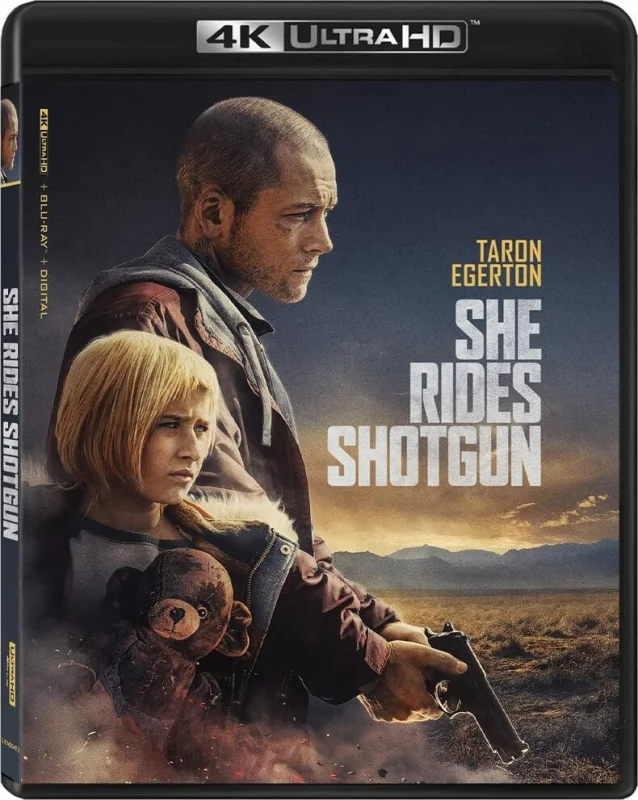
Nick Rowland presents a dark thriller centered on Nate (Taron Egerton), an ex-convict desperately trying to protect his 11-year-old daughter, Polly (Ana Sofia Heger), from a brutal attack by a ruthless neo-Nazi group.
The story begins with Polly waiting for her mom to pick her up from school. Instead, a suspicious, shaved-headed man with tattoos shows up and tries to convince the girl to get into his car. It soon becomes clear that this man is her father, who was recently released from prison. Polly knows about his criminal past, and when he appears out of the blue, it immediately arouses her suspicion.
The girl doesn’t understand why he’s driving her in the opposite direction from home. Gradually, she notices alarming details: a broken window, exposed wires under the steering wheel, a suitcase in the trunk. Polly is frightened, but at the same time she is torn by an inner conflict, because Nate is her father and she feels she can trust him, even though he has been absent for most of her life. Nate evades questions about her mother and only admits, once they’re at the motel, that they’re in danger. In prison, he made enemies among members of the neo-Nazi group “Aryan Steel,” who have vowed to kill him and everyone he cares about. Furthermore, Nate is suspected of murdering his ex-wife and kidnapping his daughter, so he is forced to hide from the police as well.
Detective John Park (Rob Young) is hot on the fugitives’ trail, determined to take down the county’s largest meth lab, run by Sheriff Hauser (John Carroll Lynch), the ruthless leader of “Aryan Steel.” Park is determined to intercept Nate and Polly before they fall into Hauser’s hands, and despite the all-encompassing corruption around him, he wants to do the right thing—even if it means putting the couple in mortal danger.
Limited resources and a lack of people he can trust leave Nate vulnerable, but he’s ready to protect his daughter at any cost. At the same time, the details of his criminal past are kept from the audience, leaving room for speculation and focusing attention on Polly—the only character whose reputation is unblemished.
Rowland’s film keeps you on the edge of your seat from the very first frames. Even in the rare moments of deceptive calm, you can sense that the situation is about to explode. However, the film is not built around car chases and shootouts, but rather on the subtly crafted relationship between father and daughter. Edgerton and Heger form a convincing and natural on-screen duo, showing what their relationship might have been like in a different, violence-free life.
Even seemingly carefree scenes—such as when Nate teaches Polly how to use a baseball bat for self-defense or cuts her hair at a motel—are tinged with bitterness, as their growing closeness unfolds against a bleak backdrop. “She Rides Shotgun” draws its power from fleeting glimpses of happiness: when Polly shows her father her math skills, or when he brings her a chocolate bar after a botched robbery that nearly cost him his life. He takes a genuine interest in her habits and hobbies, and she learns to trust him again.
Polly’s gradual transformation from a frightened child into someone who feels at home in the criminal underworld is unsettling, yet devoid of romanticization. The film manages to avoid contrived sentimentality—perhaps the biggest pitfall in films featuring children. Polly isn’t portrayed as an unrealistically wise, precocious girl—she remains a child, albeit one forced to grow up quickly. The scene in which she sacrifices her beloved teddy bear to save someone is truly heart-wrenching. Polly’s maturity contrasts with Nate’s childishness, which reveals the mindset of a petty criminal weighed down by guilt. He wants to be a good father but doesn’t know how.
“She Rides Shotgun” isn’t just a survival story; it’s an exploration of how, even in the most nightmarish circumstances, a fragile but genuine bond can form between a parent and a child. It is precisely this contradiction that makes the film so gripping and emotionally charged.
 Telegram and be the first to know about updates!