Login / Register
Guest
Codec: HEVC / H.265 (88.9 Mb/s)
Resolution: Native 4K (2160p)
HDR: Dolby Vision, HDR10
Original aspect ratio: 2.39:1
#English: DTS-HD Master Audio 2.0
#English: Dolby Digital 2.0 (Audio Commentary With Anglo-Zulu War Historian Ian Knight And Film Historian Simon Lewis)
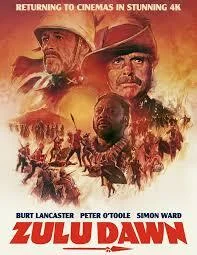
The film is dedicated to the Battle of Isandlwana—the first battle of the Anglo-Zulu War of 1879, which took place on January 22, 1879. During the battle, the Zulu army routed and virtually annihilated the British detachment under the command of Lieutenant Colonel Henry Pullain.
A brief overview of the battle: British colonial troops invaded Zulu territory to subjugate the rebellious Zulus to the British Crown “by fire and sword.” Part of the force remained at camp, while another part set out to search for the Zulus across the plains. The camp, however, remained completely unfortified. Underestimating the enemy—there is hardly anything worse for a military commander. For the enemy, as a rule, punishes such an error severely.
More than 20,000 Zulus, who had secretly surrounded the camp, descended from all sides upon the 1,700 men (half of whom were Europeans) stationed there. Neither the two cannons nor the Martini-Henry rifles, which fired 10 rounds per minute, were of any help to the British. Armed only with spears and clubs, and despite suffering heavy losses, the Zulus stormed the camp and easily capitalized on their overwhelming numerical superiority in close combat.
British forces lost more than 1,300 soldiers killed (about 800 Europeans and more than 500 native soldiers); some of the survivors were pursued by the Zulus after the battle. Ultimately, 55 Europeans and no more than 300 natives survived and made it back to British lines.
Zulu casualties ranged from 3,000 to 4,000 dead. On the one hand, the British suffered two to three times as many casualties, but on the other hand, given the staggering difference in weaponry—spears versus rapid-firing (by the standards of the time) rifles—and the fact that the attack was carried out in tight battle formations across open terrain under heavy fire, this was an unprecedented success for the natives!
For the British, however, it was a complete and humiliating rout; the remnants of Chelmsford’s force were forced to hastily withdraw from Zulu territory.
The defeat caused a huge stir. The British, of course, could not let this slide; they sent in reinforcements and eventually defeated the main Zulu forces. But the battle went down in history as one of the greatest defeats of the British colonial forces.
Let’s get back to the movie. Overall, it’s not badly made. Again, everything is authentic—the costumes, the large-scale extras, the on-location filming. It’s all “handmade”; the digital era was still as far away as the moon.
But still, the British managed to produce a rather pompous propaganda piece, as evidenced by a single scene with the banner in the film’s finale.
They came to conquer foreign lands and enslave people, but they themselves suffered a humiliating defeat—yet they supposedly fought bravely, died not in vain, and, in fact, almost won. They have no regrets; everything is right, everything is as it should be. It’s 1979—they wouldn’t make a film like this today—political correctness, you know… So in this case, oddly enough, this bombast can actually be counted as one of the film’s strengths—if only for the honesty of its stance. These days, they hypocritically churn out all sorts of pity-inducing, humanitarian films, but back then, the British clearly didn’t see themselves as guilty oppressors, and had no intention of apologizing for anything.
So overall, the film isn’t bad—it’s worth watching. And, by the way, it’s much better than the 1964 “Zulu. Therefore, if you want to check out both films, it’s better to watch the 1964 “Zulu” first, and then this one. I watched “Zulu Dawn” first, and “Zulu” seemed pretty mediocre in comparison.
 Telegram and be the first to know about updates!
 [/xfnotgiven_poster]
 [/xfnotgiven_poster]