Login / Register
Guest
Codec: HEVC / H.265 (84.8 Mb/s)
Resolution: Native 4K (2160p)
HDR: Dolby Vision, HDR10+
Aspect ratio: 1.85:1
Original aspect ratio: 1.85:1
#English: Dolby TrueHD with Dolby Atmos 7.1 (48kHz, 24-bit)
#English: Dolby Digital Plus with Dolby Atmos 5.1
#English: Dolby Digital 2.0 (Commentary by director/co-writer Bill Condon)
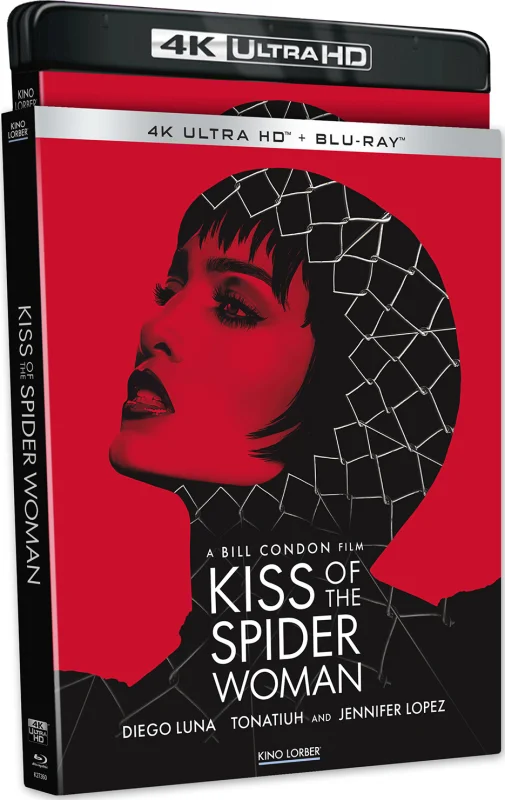
First and foremost, this is an adaptation of a Broadway musical and a musical film. Therefore, it has little in common with Hector Babenko’s film, and even less with Manuel Puig’s book. However, judging by some reviews, Bill Condon’s film often strays from both the musical’s plot and its characters.
I’m not familiar with the musical, and—a plus for the film—after watching it, I wanted to see the musical. But compared to the wonderful 1985 film, it pales in comparison, despite the vivid colors and colorful costumes.
The focus shifts to Luis Molina (Tonatiu) and his fantasy diva, a 1950s Hollywood starlet played by Jennifer Lopez. As a result, half the film is devoted to beautiful musical numbers: there’s no doubt about J.Lo’s singing and dancing talent, though the same can’t be said for her acting. Tonatiu and Diego Luna handle both their roles and the singing and dancing well. However, Molina’s portrayal is far from the original. He is young, handsome, and charming, and therefore lacks the necessary tragicomic quality. It’s hard to believe that his entire life revolves around watching movies and unrequited love.
The film isn’t without humor and memorable moments. But most of them were adapted directly from the book, and the new ideas that are sprinkled in seem anachronistic in the characters’ world.
It seems that the director, whose resume includes "Twilight" and "Chicago", doesn’t think much of his audience. What in Babenko’s film unfolded gradually and was implied between the lines is here spelled out and sung. This directness is evident right from the start in the scene where the prison guards attack Molina, and it eventually manifests itself in hints about the protagonist’s gender identity—something that simply isn’t in the original.
The most alarming thing is that the creators of this new adaptation simply cut out half the meaning. The old film was about love and politics—not politics in the literal sense, but the politics of opinion, of freedoms, the politics of the body, and, of course, the revolution. The new film focuses entirely on the romantic storyline, using revolutionary rhetoric as a backdrop and embellishment—just like a hackneyed musical within the film. Perhaps this can be explained by the shift from Molina’s experiences to Valentin’s personal turmoil: to the former, the latter’s struggle appears to be mere posturing, an adventurous note in the sentimental monotony of life. But this idea still doesn’t justify the saccharine, trite ending.
Perhaps the musical genre itself is to blame: some themes shouldn’t be accompanied by songs, dancing, and melodramatic twists. Although they don’t detract from classics like "Cabaret". Overall, the film feels unnecessary; its few merits are outweighed by the overall impression of disjointed, unpolished material, and in its eagerness to heroize the characters, it loses all the nuance and complexity of their personalities.
 Telegram and be the first to know about updates!